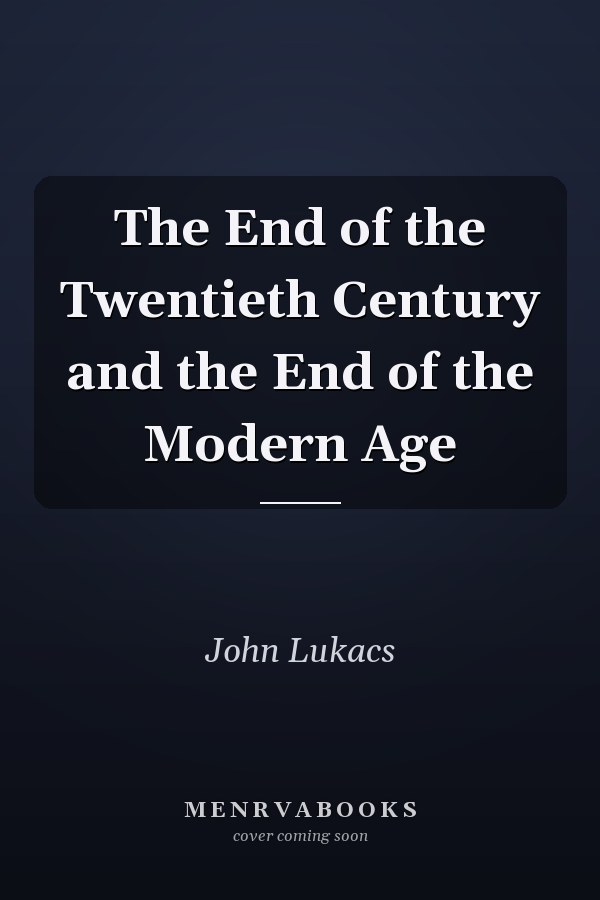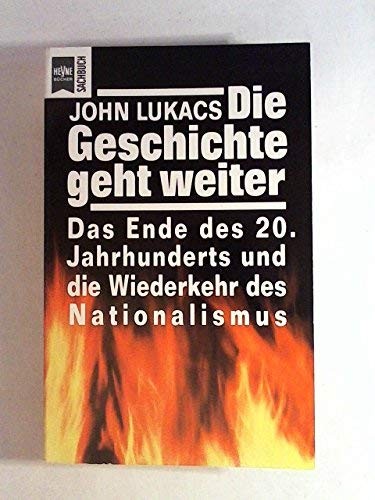
The End of the Twentieth Century and the End of the Modern Age
0
0
As an Amazon Associate and affiliate partner, Menrva Books earns from qualifying purchases. Learn more
Author Description
Historian John Lukacs's brilliant new book offers a provocative summing-up of the twentieth century, that age of iron which began with the guns of August in 1914 and ended with the collapse of the Soviet Union in 1989. Distinguished by its author's masterly style and command of detail, *The End of the Twentieth Century* is a startling examination of where we are today, how we got here, and where we are headed. Centering on Europe, America, and the relations between the two, Lukacs argues that the major battle of our time has been waged between forms of nationalism rather than between communism and democracy; that the great watershed events have been the two world wars, not the Russian Revolution; and that the century's radical revolutionary was neither Lenin nor Chairman Mao but Adolf Hitler. The book puts into sharp perspective such events as the collapse of the Soviet Union, the civil war raging in what was Yugoslavia, and the resurgence of right-wing politics in a reunited Germany. Rather than the end of history, we are now witnessing the end of the modern era, and what awaits us is not the triumphal reign of liberal democracy but a troubled time that may echo much that is most questionable in our age. Informed by the precision and insight that have made Lukacs a leading historian, *The End of the Twentieth Century* is a reckoning both personal and professional—at once a brilliant rebuttal to Francis Fukuyama's *The End of History* and an outstanding, if sobering, work of historical mediation.
Menrva's Summary
THE THESIS
The End of the Twentieth Century and the End of the Modern Age posits that the 20th century, marked by profound global upheaval, concluded not with the triumph of liberal democracy but with the close of the modern era itself. Historian John Lukacs argues that the primary conflicts were nationalistic rather than ideological, with World War I and II serving as the century's defining moments over the Russian Revolution. He contends that Adolf Hitler, not Lenin or Mao, was the century's most significant revolutionary figure, and that the future holds a troubled period echoing the questionable aspects of the modern age, rather than a 'history's end'. The book offers a critical examination of Europe and America's relationship, contextualizing events like the Soviet collapse and the Yugoslav civil war.
THE SCOPE MAP
- Analysis of the 20th century as an 'age of iron' from 1914 to 1989.
- Focus on the interplay between Europe and America.
- Argument that nationalism, not communism vs. democracy, was the central conflict.
- Identification of World War I and II as the key watershed events.
- Assertion that Adolf Hitler was the century's most radical revolutionary.
- Examination of contemporary events such as the Soviet Union's collapse and the Yugoslav civil war.
- Critique of Francis Fukuyama's 'The End of History' thesis.
- Exploration of the potential for a troubled future beyond the modern era.
THE AUTHORITY PERSPECTIVE
John Lukacs's work is characterized by its masterly style and command of detail, offering a provocative summation of the 20th century. The book is noted for its sharp analysis of historical forces, particularly its emphasis on nationalism as the driving conflict and its re-evaluation of pivotal figures and events. It serves as a direct counterpoint to theories suggesting the 'end of history,' instead forecasting a more complex and potentially unsettling future. The historical mediation provided by Lukacs is considered both personal and professional, offering a sobering perspective on our current trajectory.
Page Count:
347
Publication Date:
1996-01-01
ISBN-10:
3453091418
ISBN-13:
9783453091412
Politics
History
Non-Fiction
European History