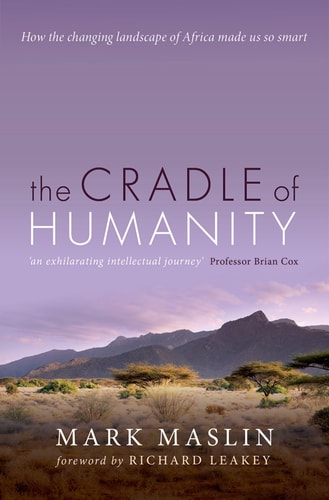
The Cradle of Humanity: How the Changing Landscape of Africa Made Us So Smart
0
0
As an Amazon Associate and affiliate partner, Menrva Books earns from qualifying purchases. Learn more
Author Description
Humans are rather weak when compared with many other animals. We are not particularly fast and have no natural weapons. Yet Homo sapiens currently number nearly 7.5 billion and are set to rise to nearly 10 billion by the middle of this century. We have influenced almost every part of the Earth system and as a consequence are changing the global environmental and evolutionary trajectory of the Earth. So how did we become the worlds apex predator and take over the planet?Fundamental to our success is our intelligence, not only individually but more importantly collectively. But why did evolution favour the brainy ape? Given the calorific cost of running our large brains, not to mention the difficulties posed for childbirth, this bizarre adaptation must have given our ancestors a considerable advantage. In this book Mark Maslin brings together the latest insights from hominin fossils and combines them with evidence of the changing landscape of the East African Rift Valley to show how all these factors led to selection pressures that favoured our ultrasocial brains. Astronomy, geology, climate, and landscape all had a part to play in making East Africa the cradle of humanity and allowing us to dominate the planet.
Menrva's Summary
THE THESIS
This book investigates the environmental and evolutionary pressures in East Africa that drove the development of human intelligence and our eventual dominance as a species. Mark Maslin, a professor of Earth System Science, synthesizes data from hominin fossil records, geological shifts in the East African Rift Valley, and climate history. He argues that the volatile landscape of the region acted as a catalyst for the evolution of our large, ultrasocial brains, providing a framework that links planetary systems to human cognitive advancement.
THE SCOPE MAP
What You Will Find
- Analysis of the East African Rift Valley's geological and climatic history.
- Synthesis of hominin fossil evidence and evolutionary biology.
- Examination of the metabolic and reproductive costs of large brain development.
- Exploration of how environmental instability acted as a selection pressure for collective intelligence.
THE AUTHORITY PERSPECTIVE
Experts and readers alike note that Maslin provides a highly accessible synthesis of complex Earth system science and paleoanthropology. The text is frequently cited for its ability to bridge the gap between geological history and the development of human social behavior.
Page Count:
272
Publication Date:
2019-03-24
Publisher:
Oxford University Press
ISBN-10:
0198704534
ISBN-13:
9780198704539
Science
History
Human beings
Climatic changes
Evolutionary Biology
Anthropology
Physical Anthropology
Paleontology
Community Tags
Similar Books














