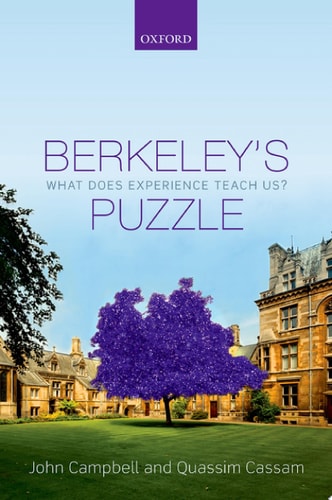
Berkeley's Puzzle: What Does Experience Teach Us
0
0
As an Amazon Associate and affiliate partner, Menrva Books earns from qualifying purchases. Learn more
Author Description
Sensory experience seems to be the basis of our knowledge and conception of mind-independent things. The puzzle is to understand how that can be: even if the things we experience (apples, tables, trees, etc), are mind-independent how does our sensory experience of them enable us to conceive of them as mind-independent? George Berkeley thought that sensory experience can only provide us with the conception of mind-dependent things, things which cannot exist when they aren't being perceived.It's easy to dismiss Berkeley's conclusion but harder to see how to avoid it. In this book, John Campbell and Quassim Cassam propose very different solutions to Berkeley's Puzzle. For Campbell, sensory experience can be the basis of our knowledge of mind-independent things because it is a relation, more primitive than thought, between the perceiver and high-level objects and properties in the mind-independent world. Cassam opposes this 'relationalist' solution to the Puzzle and defends a 'representationalist' solution: sensory experience can give us the conception of mind-independent things because it represents its objects as mind-independent, but does so without presupposing concepts of mind-independent things.This book is written in the form of a debate between two rival approaches to understanding the relationship between concepts and sensory experience. Although Berkeley's Puzzle frames the debate, the questions addressed by Campbell and Cassam aren't just of historical interest. They are among the most fundamental questions in philosophy.
Menrva's Summary
THE THESIS
This book investigates the fundamental philosophical problem of how sensory experience allows humans to conceive of mind-independent objects. John Campbell and Quassim Cassam, both distinguished philosophers, utilize the historical framework of George Berkeley’s idealism to challenge contemporary theories of perception. They present a structured debate that contrasts relationalist and representationalist accounts of how sensory input bridges the gap between the perceiver and the external world.
THE SCOPE MAP
What You Will Find
- A critical analysis of George Berkeley’s arguments regarding mind-dependent versus mind-independent existence.
- A detailed comparison between relationalist and representationalist theories of perception.
- A structured debate format that pits two distinct philosophical methodologies against one another.
- An exploration of the relationship between conceptual thought and raw sensory experience.
THE AUTHORITY PERSPECTIVE
Experts recognize this work as a significant contribution to the philosophy of perception, particularly for its clear articulation of complex epistemological problems. Readers frequently note the academic density of the prose, which makes it a valuable resource for students and scholars interested in the intersection of historical philosophy and modern cognitive theory.
Page Count:
256
Publication Date:
2014-10-21
Publisher:
Oxford University Press
ISBN-10:
0198716257
ISBN-13:
9780198716259
Philosophy
Perception
Epistemology
Experience
Metaphysics
Community Tags
Similar Books