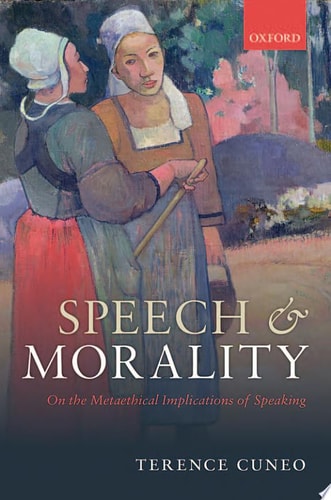
Speech and Morality: On the Metaethical Implications of Speaking
0
0
As an Amazon Associate and affiliate partner, Menrva Books earns from qualifying purchases. Learn more
Author Description
Terence Cuneo develops a novel line of argument for moral realism. The argument he defends hinges on the normative theory of speech, according to which speech acts are generated by an agent's altering her normative position with regard to her audience, gaining rights, responsibilities, and obligations of certain kinds. Some of these rights, responsibilities, and obligations, Cuneo suggests, are moral. And these moral features are best understood along realist lines, in part because they explain how it is that we can speak. If this is right, a necessary condition of being able to speak is that there are moral rights, responsibilities, and obligations of a broadly realist sort.
Menrva's Summary
THE THESIS
Does the act of speaking necessitate the existence of objective moral realities? Terence Cuneo, a professor of philosophy, investigates the intersection of speech act theory and metaethics to argue for moral realism. By analyzing the normative structure inherent in communication, he posits that the rights and obligations generated during speech acts are fundamentally moral in nature and require a realist framework to be coherent.
THE SCOPE MAP
What You Will Find
- An analysis of the normative theory of speech acts and their implications for moral philosophy.
- A defense of moral realism based on the necessary conditions of human communication.
- Examination of the rights, responsibilities, and obligations inherent in speaker-audience interactions.
- A logical framework connecting linguistic performance to objective moral properties.
THE AUTHORITY PERSPECTIVE
Philosophical scholars recognize this text as a significant contribution to the debate between moral realism and anti-realism. Readers frequently note the technical density of the prose, which requires a strong background in metaethical terminology to fully grasp the author's arguments.
Page Count:
224
Publication Date:
2014-10-07
Publisher:
Oxford University Press
ISBN-10:
0198712723
ISBN-13:
9780198712725
Philosophy
Ethics
Moral Philosophy
Metaethics
Community Tags
Similar Books