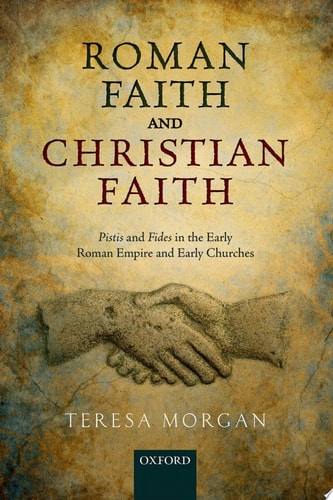
Roman Faith and Christian Faith: Pistis and Fides in the Early Roman Empire and Early Churches
0
0
As an Amazon Associate and affiliate partner, Menrva Books earns from qualifying purchases. Learn more
Author Description
This study investigates why "faith" (pistis/fides) was so important to early Christians that the concept and praxis dominated the writings of the New Testament. It argues that such a study must be interdisciplinary, locating emerging Christianities in the social practices and mentalites of contemporary Judaism and the early Roman empire. This can, therefore, equally be read as a study of the operation of pistis/fides in the world of the early Roman principate, taking one small but relatively well-attested cult as a case study in how micro-societies within that world could treat it distinctively.Drawing on recent work in sociology and economics, the book traces the varying shapes taken by pistis/fides in Greek and Roman human and divine-human relationships: whom or what is represented as easy or difficult to trust or believe in; where pistis/fides is "deferred" and "reified" in practices such as oaths and proofs; how pistis/fides is related to fear, doubt and scepticism; and which foundations of pistis/fides are treated as more or less secure.The book then traces the evolution of representations of human and divine-human pistis in the Septuagint, before turning to pistis/pisteuein in New Testament writings and their role in the development of early Christologies (incorporating a new interpretation of pistis Christou) and ecclesiologies. It argues for the integration of the study of pistis/pisteuein with that of New Testament ethics. It explores the interiority of Graeco-Roman and early Christian pistis/fides. Finally, it discusses eschatological pistis and the shape of the divine-human community in the eschatological kingdom.
Menrva's Summary
THE THESIS
This study investigates the fundamental role of faith (pistis/fides) in early Christian development by situating it within the broader social practices and mentalities of the early Roman Empire. Teresa Morgan, a scholar of classical and early Christian studies, employs an interdisciplinary framework that integrates sociology and economics to analyze how these concepts functioned in both human and divine-human relationships. By examining the linguistic and cultural evolution of these terms from the Greek and Roman worlds into the Septuagint and New Testament, the author argues that faith was not merely a theological abstraction but a central social practice that shaped early Christologies and ecclesiologies.
THE SCOPE MAP
What You Will Find
- Comparative analysis of pistis and fides within the social and economic structures of the early Roman principate.
- Examination of the evolution of faith-based concepts from the Septuagint into New Testament writings.
- Application of sociological and economic theories to understand trust, oaths, and skepticism in ancient micro-societies.
- Exploration of the intersection between faith, ethics, and eschatology in early Christian communities.
THE AUTHORITY PERSPECTIVE
Scholars frequently highlight this work as a rigorous, foundational text for understanding the semantic and social history of faith in the ancient world. The prose is noted for its high academic density, making it a primary resource for researchers in classics, theology, and early church history.
Page Count:
688
Publication Date:
2015-07-28
Publisher:
Oxford University Press
ISBN-10:
0198724144
ISBN-13:
9780198724148
History
Religion
Christianity
Sociology
Theology
Community Tags
Similar Books