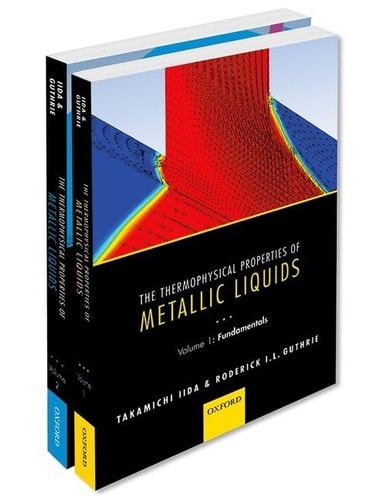
The Thermophysical Properties of Metallic Liquids
0
0
As an Amazon Associate and affiliate partner, Menrva Books earns from qualifying purchases. Learn more
Author Description
This two volume set provides a clear understanding of the essence of a metallic liquid's thermophysical properties which is indispensable for improving, or innovating any liquid metal processing operation or product quality. The thermophysical properties of metallic liquids are presented, i.e. liquid metals, semimetals, and semiconductors, analysed in relation to our current understanding of the underlying structure of a metallic liquid on the atomic scale and of the electron configuration of an element. The authors' interdisciplinary approach brings together knowledge from various subject areas including: process metallurgy, materials science, condensed matter physics, chemistry, metrology. They introduce new dimensionless parameters to characterise the atomic states of metallic liquids (i.e. an atom's hardness or softness, its anharmonic motions, and the spatial arrangement of the atoms in a metallic liquid), as revealed through data for the velocity of sound in the metallic liquids. The two new simple parameters, common to all elements, allow for better predictions of several important thermophysical properties of liquid metallic elements.
Menrva's Summary
THE THESIS
This two-volume work investigates the relationship between the atomic-scale structure of metallic liquids and their macroscopic thermophysical properties to improve industrial processing and product quality. Authors Roderick I. L. Guthrie and Takamichi Iida utilize an interdisciplinary framework that synthesizes process metallurgy, condensed matter physics, and chemistry. By analyzing the electron configuration and atomic states of liquid metals, semimetals, and semiconductors, the authors propose new dimensionless parameters to predict material behavior with greater accuracy.
THE SCOPE MAP
What You Will Find
- Comprehensive analysis of thermophysical properties for liquid metals, semimetals, and semiconductors.
- Introduction of new dimensionless parameters for characterizing atomic hardness, softness, and anharmonic motion.
- Integration of data regarding the velocity of sound in metallic liquids to explain spatial atomic arrangements.
- Cross-disciplinary methodology combining metrology, materials science, and metallurgical process engineering.
THE AUTHORITY PERSPECTIVE
Experts recognize this set as a specialized reference for researchers and engineers working in high-temperature liquid metal processing. Readers frequently note the technical density of the prose, which requires a strong background in physics and materials science to fully utilize the proposed predictive models.
Page Count:
448
Publication Date:
2015-12-15
Publisher:
Oxford University Press
ISBN-10:
0198729820
ISBN-13:
9780198729822
Science
Engineering
Physics
Chemistry
Liquid Metals
Metallurgy
Community Tags
Similar Books