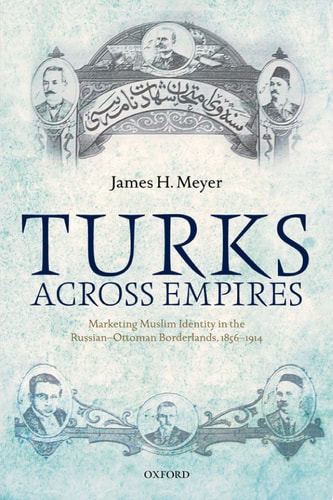
Turks Across Empires: Marketing Muslim Identity in the Russian-Ottoman Borderlands, 1856-1914
0
0
As an Amazon Associate and affiliate partner, Menrva Books earns from qualifying purchases. Learn more
Author Description
Turks Across Empires tells the story of the pan-Turkists, Muslim activists from Russia who gained international notoriety during the Young Turk era of Ottoman history. Yusuf Akcura, Ismail Gasprinskii and Ahmet Agaoglu are today remembered as the forefathers of Turkish nationalism, but in the decade preceding the First World War they were known among bureaucrats, journalists and government officials in Russia and Europe as dangerous Muslim radicals. This volume traces the lives and undertakings of the pan-Turkists in the Russian and Ottoman empires, examining the ways in which these individuals formed a part of some of the most important developments to take place in the late imperial era.James H. Meyer draws upon a vast array of sources, including personal letters, Russian and Ottoman state archival documents, and published materials to recapture the trans-imperial worlds of the pan-Turkists. Through his exploration of the lives of Akcura, Gasprinskii and Agaoglu, Meyer analyzes the bigger changes taking place in the imperial capitals of Istanbul and St. Petersburg, as well as on the ground in central Russia, Crimea and the Caucasus.Turks Across Empires focuses especially upon three developments occurring in the final decades of empire: an explosion in human mobility across borders, the outbreak of a wave of revolutions in Russia and the Middle East, and the emergence of deeply politicized forms of religious and national identity. As these are also important characteristics of the post-Cold War era, argues Meyer, the events surrounding the pan-Turkists provide valuable lessons regarding the nature of present-day international and cross-cultural geopolitics.
Menrva's Summary
THE THESIS
This volume investigates how a group of Muslim activists from Russia, known as the pan-Turkists, navigated the shifting geopolitical landscapes of the late Russian and Ottoman empires to shape modern Turkish nationalism. James H. Meyer, a historian specializing in the late imperial era, utilizes a comprehensive range of primary sources, including personal correspondence and state archival documents from both Russia and the Ottoman Empire. By focusing on figures such as Yusuf Akcura, Ismail Gasprinskii, and Ahmet Agaoglu, the author constructs a framework that links the radical political movements of the early 20th century to the broader structural changes occurring in Istanbul and St. Petersburg.
THE SCOPE MAP
What You Will Find
- Analysis of the pan-Turkist movement during the Young Turk era between 1856 and 1914.
- Examination of human mobility and migration patterns across the Russian-Ottoman borderlands.
- Use of primary source materials including state archives, personal letters, and contemporary journalistic accounts.
- Exploration of the intersection between politicized religious identity and the rise of nationalism in the pre-World War I era.
THE AUTHORITY PERSPECTIVE
Scholars and historians recognize this work as a significant contribution to the study of trans-imperial networks and the origins of modern Turkish political identity. Readers frequently note the meticulous archival research and the author's ability to connect historical developments to contemporary geopolitical themes.
Page Count:
256
Publication Date:
2014-12-30
Publisher:
Oxford University Press
ISBN-10:
0198725140
ISBN-13:
9780198725145
History
Turkey
Kindle Store
Muslims
Russia federation relations
Russia
Turkic Peoples
European History
Imperialism
Middle Eastern
Nationalism
Kindle eBooks
Categories
Educational Resources
Community Tags
Similar Books