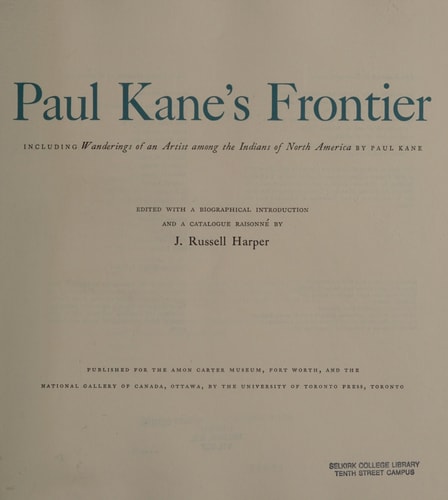
Paul Kane's Frontier, Including Wanderings of an Artist Among the Indians of North America
0
0
As an Amazon Associate and affiliate partner, Menrva Books earns from qualifying purchases. Learn more
Author Description
In the 1840's, Paul Kane travelled the far reaches of the North American West, from the Great Lakes along the fur-trade routes to the coast, sketching a visual record of the Indian cultures of that vast area. With the publication of this study of his life and career, Kane emerges as a major figure among North American artists of the 19th century. Hundreds of his sketches are examined together for the first time. The range of his subjects offers important visual documentation for the story of the North American West.The 48 color plates and 204 black-and-white illustrations included in this volume reveal Paul Kane's frontier as a region of endless fascination. Katne's immediate inspiration seems to have been the work of George Catlin, who had become a celebrity in England in the 1840s when Kane met him. Like Catlin, he felt compelled to preserve for posterity a record of the Indian chieftains, the customs of the tribes and the lands where they lived before change had made such a record impossible.Kane assembled this gallery on arduous journeys in 1845 and 1846-1848. By canoe and packhorse or on foot he travelled across the continent from the Great Lakes westward along the fur-trade routes across the prairies and the Rocky Mountains, down the Columbia River into the Oregon, and up the coast to Vancouver Island. Everywhere along the way he made sketches, in pencil, watercolor, or oil.
Menrva's Summary
THE THESIS
This volume examines the life and artistic career of Paul Kane, a 19th-century artist who documented Indigenous cultures and the North American West. The book analyzes Kane's arduous journeys from the Great Lakes to the Pacific coast, undertaken in the 1840s, where he created a visual record of the peoples and landscapes he encountered. It highlights how Kane, inspired by George Catlin, felt compelled to preserve the image of Indigenous chieftains, tribal customs, and their lands before they were irrevocably altered by change. The study presents hundreds of Kane's sketches, many examined together for the first time, offering significant visual documentation of the historical West.
THE SCOPE MAP
- Analysis of Paul Kane's artistic development and influences, including George Catlin.
- Detailed examination of Kane's travels across North America in the 1840s, including routes via canoe, packhorse, and foot.
- Exploration of the visual documentation of Indigenous cultures, customs, and leaders.
- Presentation of the landscapes and environments of the North American West as depicted by Kane.
- Inclusion of 48 color plates and 204 black-and-white illustrations showcasing Kane's sketches and paintings.
- Discussion of the historical context and the imperative to record cultures before societal changes occurred.
- Assessment of Kane's position as a major figure in 19th-century North American art.
THE AUTHORITY PERSPECTIVE
This study positions Paul Kane as a significant 19th-century North American artist, with the book's comprehensive examination of his life and career drawing attention to his visual documentation of Indigenous cultures and the Western frontier. The volume's extensive use of illustrations, including numerous color plates, allows for a detailed appreciation of his work and the historical context it captures. The analysis emphasizes Kane's motivation to preserve a record of Native American life and landscapes, mirroring the efforts of contemporaries like George Catlin. The book serves as an important resource for understanding both the art history and the social history of the period.
Page Count:
350
Publication Date:
1971-01-01
Publisher:
University of Toronto Press
ISBN-10:
0802017347
ISBN-13:
9780802017345
History
Biography
Art
Non-Fiction
Illustration
Art History
Community Tags
Similar Books














