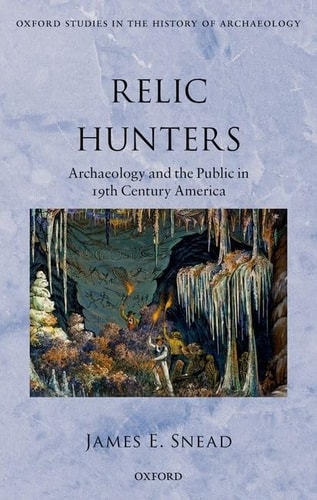
Relic Hunters: Archaeology and the Public in Nineteenth-Century America
0
0
As an Amazon Associate and affiliate partner, Menrva Books earns from qualifying purchases. Learn more
Author Description
Relic Hunters is a study of the complex relationship between the people of 19th century America with the material antiquities of North America's indigenous past. As scholars struggled to explain their existence, farmers in Ohio were plowing up arrowheads, building their houses atop burial mounds, and developing their own ideas about antiquity. They experienced the new country as a "place with history" reflected in material traces that became important touch points for scientific knowledge, but for American cultural identity as well.Relic Hunters traces the encounter with American antiquities from 1812 to 1879. This encompasses the period when archaeology took root in the United States: it also spans the "deep settlement" of the Midwest and sectional strife both before and after the Civil War. At the center of the story is the first iconic find of American archaeology, known as "the Kentucky Mummy." Discovered deep in a cavern, this dessicated burial became the subject of scholarly competition, traveling exhibitions, and even poetry. The book uses the theme of the Kentucky Mummy to structure the broader story of the public and American antiquities, a tour that leads through rural museums, mound excavations, lecture tours, shady deals, and ultimately into the famous attic of the Smithsonian Institution.Ultimately, Relic Hunters is a story of the American landscape, and of the role of archaeology in shaping that place. Derived from letters, memoranda, and reports found in more than a dozen archives, this is a unique account of a critical encounter that shaped local and national identity in ways that are only now being explored.
Menrva's Summary
THE THESIS
How did the discovery and interpretation of indigenous antiquities shape the development of American national identity and scientific practice during the nineteenth century? James E. Snead, an expert in the history of archaeology, examines the intersection of public curiosity and academic inquiry between 1812 and 1879. By analyzing archival correspondence and reports, he argues that the physical encounter with burial mounds and artifacts served as a foundational element in how Americans conceptualized their landscape and history during a period of rapid westward expansion and internal conflict.
THE SCOPE MAP
What You Will Find
- A detailed historical analysis of American archaeology from 1812 to 1879.
- An investigation into the cultural significance of the Kentucky Mummy as a focal point for public and scholarly interest.
- Primary source research derived from letters, memoranda, and reports across over a dozen archives.
- An exploration of the tension between amateur relic hunting and the professionalization of archaeological institutions like the Smithsonian.
THE AUTHORITY PERSPECTIVE
Scholars and historians recognize this work as a significant contribution to the history of American science and cultural identity. Readers frequently note the meticulous archival research and the clarity with which the author connects local relic collecting to broader national narratives.
Page Count:
320
Publication Date:
2018-11-20
Publisher:
Oxford University Press
ISBN-10:
0198736274
ISBN-13:
9780198736271
History
Archaeology
Anthropology
American History
Community Tags
Similar Books














