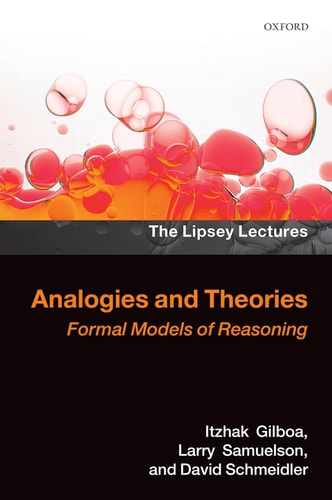
Analogies and Theories: Formal Models of Reasoning
0
0
As an Amazon Associate and affiliate partner, Menrva Books earns from qualifying purchases. Learn more
Author Description
The book describes formal models of reasoning that are aimed at capturing the way that economic agents, and decision makers in general think about their environment and make predictions based on their past experience. The focus is on analogies (case-based reasoning) and general theories (rule-based reasoning), and on the interaction between them, as well as between them and Bayesian reasoning. A unified approach allows one to study the dynamics of inductive reasoning in terms of the mode of reasoning that is used to generate predictions.
Menrva's Summary
THE THESIS
This book investigates the formal mathematical structures that underpin human reasoning, specifically how agents synthesize past experiences to navigate uncertain environments. The authors, David Schmeidler, Itzhak Gilboa, and Larry Samuelson, leverage their extensive backgrounds in economic theory and decision science to construct a rigorous framework for inductive reasoning. By contrasting case-based reasoning with rule-based systems, they provide a unified model that explains how individuals generate predictions and adapt their decision-making processes over time.
THE SCOPE MAP
What You Will Find
- Formal models of case-based reasoning and rule-based reasoning.
- Comparative analysis of Bayesian reasoning versus inductive heuristics.
- Mathematical frameworks for modeling the dynamics of belief formation.
- Theoretical exploration of how agents switch between different modes of reasoning.
THE AUTHORITY PERSPECTIVE
Experts recognize this text as a sophisticated contribution to the field of decision theory, particularly for its integration of disparate reasoning models into a single analytical framework. Readers frequently note the high level of mathematical density, making it a specialized resource for graduate-level students and researchers in economics.
Page Count:
160
Publication Date:
2015-07-14
Publisher:
Oxford University Press
ISBN-10:
0198738021
ISBN-13:
9780198738022
Economics
Philosophy
Mathematics
Economics
Decision Theory
Reasoning
Community Tags
Similar Books