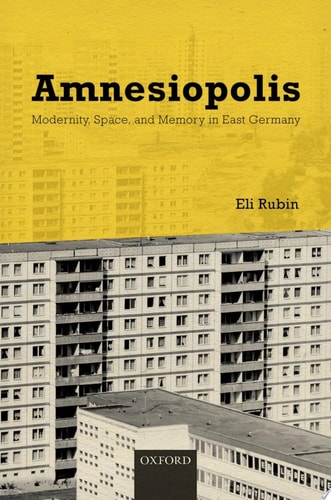
Amnesiopolis: Modernity, Space, and Memory in East Germany
0
0
As an Amazon Associate and affiliate partner, Menrva Books earns from qualifying purchases. Learn more
Author Description
Amnesiopolis explores the construction of Marzahn, the largest prefabricated housing project in East Germany, built on the outskirts of East Berlin in the 1970s and 1980s and touted by the regime as the future of socialism. It focuses particularly on the experience of East Germans who moved, often from crumbling slums left over as a legacy of the nineteenth century, into this radically new place -- one defined by pure functionality and rationality -- a material manifestation of the utopian promise of socialism.Eli Rubin employs methodologies from critical geography, urban history, architectural history, environmental history, and everyday life history to ask whether their experience was a radical break with their personal pasts and the German past. Amnesiopolis asks: can a dramatic change in spatial and material surroundings sever the links of memory that tie people to their old life narratives, and if so, does that help build a new socialist mentality in the minds of historical subjects? The answer is yes and no -- as much as the East German state tried to create a completely new socialist settlement, divorced of any links to the pre-socialist past, the massive construction project uncovered the truth buried -- literally -- in the ground, which was that the urge to colonize the outskirts of Berlin was not new at all. Furthermore, the construction of a new city out of nothing, using repeating, identical buildings, created a panopticon-like effect, giving the Stasi the possibility of more complete surveillance than they previously had.
Menrva's Summary
THE THESIS
Can a radical transformation of the physical environment effectively sever the collective memory and personal history of a population to foster a new socialist consciousness? Eli Rubin, a historian specializing in modern German history, investigates the construction of Marzahn, East Germany's largest prefabricated housing project. By synthesizing urban history, critical geography, and environmental studies, Rubin examines how the state attempted to engineer a new socialist mentality through the creation of a functional, rationalized living space. The work argues that while the state sought to erase the pre-socialist past, the material reality of the land and the persistence of human memory created a complex, contradictory experience for its residents.
THE SCOPE MAP
What You Will Find
- Historical analysis of the Marzahn housing project in East Berlin during the 1970s and 1980s.
- Methodologies drawn from critical geography, architectural history, and everyday life history.
- Examination of the panopticon-like surveillance capabilities afforded by standardized urban design.
- Investigation into the tension between state-mandated utopian planning and the persistence of historical memory.
THE AUTHORITY PERSPECTIVE
Scholars and historians recognize this work as a significant contribution to the study of East German urbanism and the intersection of space and state power. Readers frequently note the interdisciplinary approach, which effectively bridges the gap between architectural theory and the lived experiences of citizens under the socialist regime.
Page Count:
208
Publication Date:
2016-04-04
Publisher:
Oxford University Press
ISBN-10:
0198732260
ISBN-13:
9780198732266
History
Architecture
Public Housing
Housing policy
Germany
Berlin Germany
European History
Socialism
Sociology
urban planning
Community Tags
Similar Books