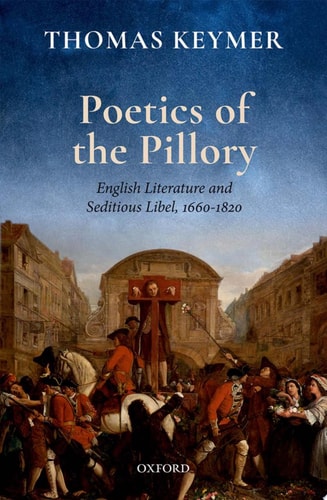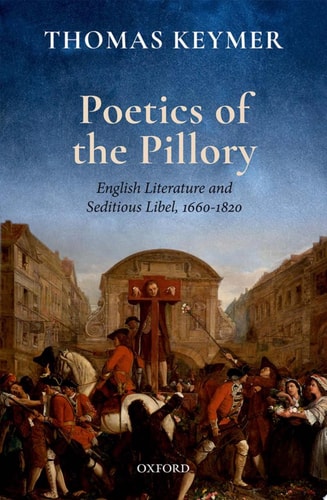
Poetics of the Pillory: English Literature and Seditious Libel, 1660-1820
0
0
As an Amazon Associate and affiliate partner, Menrva Books earns from qualifying purchases. Learn more
Author Description
On the lapse of the Licensing Act in 1695, Thomas Macaulay wrote in his History of England, 'English literature was emancipated, and emancipated for ever, from the control of the government'. It's certainly true that the system of prior restraint enshrined in this Restoration measure was now at an end, at least for print. Yet the same cannot be said of government control, which came to operate instead by means of post-publication retribution, not pre-publication licensing, notably for the common-law offence of seditious libel. For many of the authors affected, from Defoe to Cobbett, this new regime was a greater constraint on expression than the old, not least for its alarming unpredictability, and for the spectacular punishment--the pillory--that was sometimes entailed. Yet we may also see the constraint as an energizing force. Throughout the eighteenth century and into the Romantic period, writers developed and refined ingenious techniques for communicating dissident or otherwise contentious meanings while rendering the meanings deniable.As a work of both history and criticism, this book traces the rise and fall of seditious libel prosecution, and with it the theatre of the pillory, while arguing that the period's characteristic forms of literary complexity--ambiguity, ellipsis, indirection, irony--may be traced to the persistence of censorship in the post-licensing world. The argument proceeds through case studies of major poets and prose writers including Dryden, Defoe, Pope, Fielding, Johnson, and Southey, and also calls attention to numerous little-known satires and libels across the extended period.
Menrva's Summary
THE THESIS
This work investigates how the persistence of seditious libel prosecution in post-1695 England fundamentally shaped the stylistic evolution of eighteenth-century literature. Thomas Keymer, a scholar of the period, examines the transition from pre-publication licensing to a regime of post-publication retribution. He argues that the constant threat of legal action and the public spectacle of the pillory forced writers to adopt complex rhetorical strategies to communicate dissent while maintaining plausible deniability. By analyzing the intersection of law and aesthetics, Keymer demonstrates that the era's characteristic literary techniques were direct responses to state-imposed constraints.
THE SCOPE MAP
What You Will Find
- A historical analysis of seditious libel laws and the decline of the pillory between 1660 and 1820.
- Examination of literary techniques including irony, ambiguity, ellipsis, and indirection as defensive mechanisms.
- Case studies of prominent authors such as Dryden, Defoe, Pope, Fielding, Johnson, and Southey.
- A survey of lesser-known satires and libels that illustrate the broader climate of political expression.
THE AUTHORITY PERSPECTIVE
Scholars recognize this text as a significant contribution to the study of eighteenth-century print culture and the history of censorship. Readers frequently note the academic density of the prose and the author's ability to bridge the gap between legal history and literary criticism.
Page Count:
352
Publication Date:
2019-12-24
Publisher:
Oxford University Press
ISBN-10:
0198744498
ISBN-13:
9780198744498
History
Ethnic
Sedition
Law and literature
Censorship
18th century
Literary Criticism
Humanities - Music - Ethnic
Great Britain
English literature
Humanities - Music - Ethnomusicology
Political History
Community Tags
Similar Books