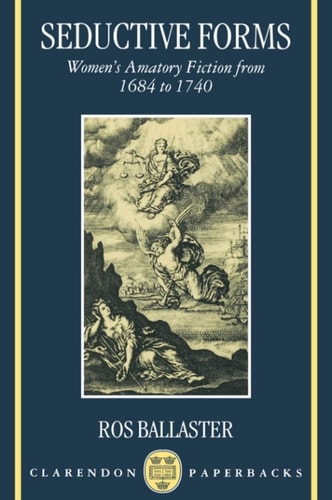
Seductive Forms: Women's Amatory Fiction from 1684 to 1740
0
0
As an Amazon Associate and affiliate partner, Menrva Books earns from qualifying purchases. Learn more
Author Description
Historicist and feminist accounts of the "rise of the novel" have neglected the phenomenon of the professional woman writer in England prior to the advent of the sentimental novel in the 1740s. Seductive Forms explores the means by which the three leading Tory women novelists of the late seventeenth and early eighteenth centuries challenged and reworked both contemporary gender ideologies and generic convention. The seduction plot provided Aphra Behn, Delarivier Manley, and Eliza Haywood with a vehicle for dramatizing their own appropriation of the "masculine" power of fiction-making. Seduction is employed in these fictions as a metaphor for both novelistic production (the seduction of the reader by the writer) and party political machination (the seduction of the public by the politician). The book also explores the debts early prose fiction owes to French seventeenth-century models of fiction-writing and argues that Behn, Manley, and Haywood succeeded in producing a distinctively "English" and female "form" for an amatory novel.
Menrva's Summary
THE THESIS
This work investigates how early professional women writers in England utilized the amatory novel to challenge prevailing gender ideologies and establish a distinct literary form between 1684 and 1740. Ros Ballaster, a scholar of eighteenth-century literature, examines the works of Aphra Behn, Delarivier Manley, and Eliza Haywood to argue that these authors used the seduction plot as a sophisticated metaphor for both the act of writing and political manipulation. By analyzing these texts, the author demonstrates how these women claimed authority over the masculine-dominated sphere of fiction-making during a critical period of literary evolution.
THE SCOPE MAP
What You Will Find
- Analysis of the works of Aphra Behn, Delarivier Manley, and Eliza Haywood.
- Examination of the seduction plot as a narrative device and political metaphor.
- Investigation of the influence of seventeenth-century French prose models on English fiction.
- Discussion of the transition from early amatory fiction to the sentimental novel of the 1740s.
THE AUTHORITY PERSPECTIVE
Scholars recognize this text as a significant contribution to the study of early modern women writers and the development of the English novel. Readers frequently note the academic rigor and historical depth Ballaster brings to her analysis of gender and genre conventions.
Page Count:
240
Publication Date:
1998-06-11
Publisher:
Clarendon Press
ISBN-10:
0198184778
ISBN-13:
9780198184775
History
Literary Criticism
18th century
Feminist Theory
Literary Form
Authors fiction
Gender Studies
English literature
Women and literature
Fiction authorship
Seduction