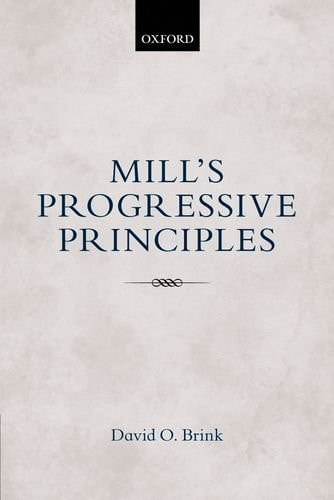
Mill's Progressive Principles
0
0
As an Amazon Associate and affiliate partner, Menrva Books earns from qualifying purchases. Learn more
Author Description
In Mill's Progressive Principles David Brink provides a systematic reconstruction and assessment of John Stuart Mill's contributions to the utilitarian and liberal traditions, examining his first principles and their application to issues of representative democracy and sexual equality. Brink defends novel interpretations of key elements in Mill's moral and political philosophy, including his concepts of motivation, happiness, duty, proof, harm and the harm principle, freedom of expression, anti-paternalism, representative democracy and weighted voting, and sexual equality. However, the most distinctive aspect of this account of Mill's commitments is the case it makes for a perfectionist reading of his conception of happiness and the significance this has for other aspects of his moral and political philosophy. On this perfectionist conception, the chief ingredients of happiness involve the exercise of a person's capacities for practical deliberation and decision that mark us as progressive beings. Once this perfectionist theme is made explicit, it can be shown to be central to Mill's views about utilitarianism, liberalism, rights, democratic government, and sexual equality.
Menrva's Summary
THE THESIS
This work investigates whether John Stuart Mill’s moral and political philosophy is best understood through a perfectionist interpretation of happiness. Professor David O. Brink, a scholar of ethics and political theory, reconstructs Mill’s core principles to demonstrate how the exercise of human capacities for practical deliberation serves as the foundation for his utilitarian and liberal commitments. By analyzing Mill’s writings on democracy, rights, and equality, the author argues that a perfectionist reading provides a more coherent framework for understanding Mill’s diverse philosophical contributions.
THE SCOPE MAP
What You Will Find
- A systematic reconstruction of Mill’s utilitarian and liberal traditions.
- An analysis of the perfectionist conception of happiness as a driver for moral and political action.
- Examination of specific applications including the harm principle, anti-paternalism, and weighted voting.
- A critical assessment of Mill’s views on sexual equality and representative democracy.
THE AUTHORITY PERSPECTIVE
Scholars and students of political philosophy recognize this text as a rigorous, systematic re-evaluation of Mill’s foundational arguments. Readers frequently note the academic density of the prose, which serves as a significant resource for those engaged in advanced study of 19th-century liberal thought.
Page Count:
336
Publication Date:
2015-10-01
Publisher:
Oxford University Press
ISBN-10:
0198744390
ISBN-13:
9780198744399
Philosophy
Political Philosophy
Utilitarianism
Ethics
Liberalism
Community Tags
Similar Books