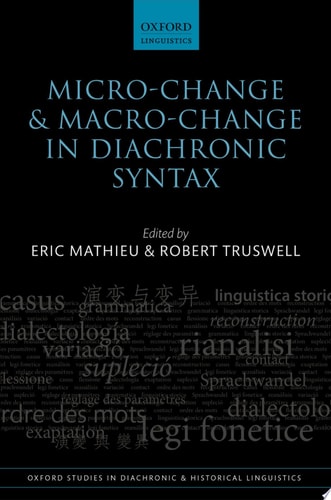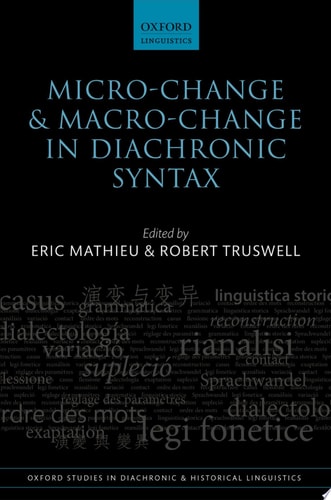
Micro-change and Macro-change in Diachronic Syntax
0
0
As an Amazon Associate and affiliate partner, Menrva Books earns from qualifying purchases. Learn more
Author Description
The chapters in this volume address the process of syntactic change at different granularities. The language-particular component of a grammar is now usually assumed to be nothing more than the specification of the grammatical properties of a set of lexical items. Accordingly, grammar change must reduce to lexical change. And yet these micro-changes can cumulatively alter the typological character of a language (a macro-change). A central puzzle in diachronic syntax is how to relate macro-changes to micro-changes. Several chapters in this volume describe specific micro-changes: changes in the syntactic properties of a particular lexical item or class of lexical items. Other chapters explore links between micro-change and macro-change, using devices such as grammar competition at the individual and population level, recurring diachronic pathways, and links between acquisition biases and diachronic processes. This book is therefore a great companion to the recent literature on the micro- versus macro-approaches to parameters in synchronic syntax. One of its important contributions is the demonstration of how much we can learn about synchronic linguistics through the way languages change: the case studies included provide diachronic insight into many syntactic constructions that have been the target of extensive recent synchronic research, including tense, aspect, relative clauses, stylistic fronting, verb second, demonstratives, and negation. Languages discussed include several archaic and contemporary Romance and Germanic varieties, as well as Greek, Hungarian, and Chinese, among many others.
Menrva's Summary
THE THESIS
This volume investigates the theoretical relationship between granular, lexical-level syntactic shifts and the broader, typological transformations observed in language evolution. The editors, Éric Mathieu and Robert Truswell, compile research that addresses the central puzzle of how micro-changes in lexical properties cumulatively result in macro-changes within a language's structure. The text utilizes a framework that treats grammar change as a reduction to lexical change, exploring how acquisition biases and grammar competition drive these diachronic processes.
THE SCOPE MAP
What You Will Find
- Analysis of syntactic change across Romance, Germanic, Greek, Hungarian, and Chinese language varieties.
- Theoretical frameworks linking individual lexical item shifts to population-level typological change.
- Case studies on specific syntactic constructions including tense, aspect, relative clauses, and verb second phenomena.
- Methodologies incorporating grammar competition models and acquisition bias analysis.
THE AUTHORITY PERSPECTIVE
Experts identify this volume as a significant contribution to the ongoing debate regarding parameter-based approaches in synchronic and diachronic syntax. Readers frequently note the academic density of the prose, making it a specialized resource for researchers and advanced students of historical linguistics.
Page Count:
400
Publication Date:
2017-09-06
Publisher:
Oxford University Press
ISBN-10:
0198747845
ISBN-13:
9780198747840
Linguistics
Historical linguistics
Academic
Reference
Syntax