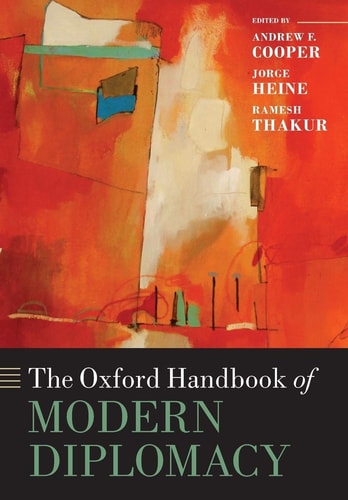
The Oxford Handbook of Modern Diplomacy
0
0
As an Amazon Associate and affiliate partner, Menrva Books earns from qualifying purchases. Learn more
Author Description
At a time when diplomatic practices and the demands imposed on diplomats are changing quite radically, and many foreign ministries feel they are being left behind, there is a need to understand the various forces that are affecting the profession. Diplomacy remains a salient activity in today's world in which the basic authoritative actor is still the state. At the same time, in some respects the practice of diplomacy is undergoing significant, even radical, changes to the context, tools, actors and domain of the trade. These changes spring from the changing nature of the state, the changing nature of the world order, and the interplay between them. One way of describing this is to say that we are seeing increased interaction between two forms of diplomacy, 'club diplomacy' and 'network diplomacy'. The former is based on a small number of players, a highly hierarchical structure, based largely on written communication and on low transparency; the latter is based on a much larger number of players (particularly of civil society), a flatter structure, a more significant oral component, and greater transparency.The Oxford Handbook of Modern Diplomacy is an authoritative reference tool for those studying and practicing modern diplomacy. It provides an up-to-date compendium of the latest developments in the field. Written by practitioners and scholars, the Handbook describes the elements of constancy and continuity and the changes that are affecting diplomacy. The Handbook goes further and gives insight to where the profession is headed in the future. Co-edited by three distinguished academics and former practitioners, the Handbook provides comprehensive analysis and description of the state of diplomacy in the 21st Century and is an essential resource for diplomats, practitioners and academics. Featured as part of United Nations University panel on "The End of Diplomacy?" unu.edu/news/news/unu-hosts-panel-discussion-on-modern-diplomacy.html
Menrva's Summary
THE THESIS
This volume investigates how the traditional practice of state-based diplomacy is evolving in response to radical shifts in global power structures and the emergence of new non-state actors. The editors, Andrew F. Cooper, Jorge Heine, and Ramesh Thakur, leverage their combined expertise as both scholars and former practitioners to synthesize a comprehensive framework for understanding 21st-century international relations. By analyzing the tension between traditional 'club diplomacy' and modern 'network diplomacy,' the text provides a rigorous assessment of how foreign ministries must adapt to maintain relevance in an increasingly transparent and interconnected world order.
THE SCOPE MAP
What You Will Find
- Analysis of the transition from hierarchical, state-centric models to flatter, network-based diplomatic structures.
- Examination of the role of civil society and non-state actors in contemporary international negotiations.
- Comparative studies of diplomatic tools, including the shift from written communication to oral and digital engagement.
- Projections on the future trajectory of the diplomatic profession and the changing nature of the state.
THE AUTHORITY PERSPECTIVE
Experts and academics recognize this volume as a foundational reference for the study of modern international affairs. Readers frequently note the academic density of the prose, which serves as a comprehensive resource for both seasoned diplomats and students of political science.
Page Count:
990
Publication Date:
2015-06-09
Publisher:
Oxford University Press
ISBN-10:
0198743661
ISBN-13:
9780198743668
History
International relations
Reference
Diplomacy
Community Tags
Other Editions(2)
Similar Books
Reader Comments
Share Your Thoughts
No comments yet. Be the first to share your thoughts!