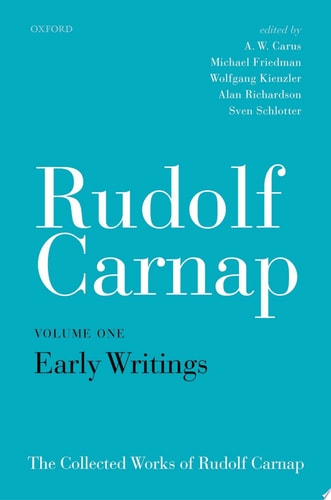
Rudolf Carnap: Early Writings: The Collected Works of Rudolf Carnap, Volume 1
0
0
As an Amazon Associate and affiliate partner, Menrva Books earns from qualifying purchases. Learn more
Author Description
Rudolf Carnap (1891-1970) is generally acknowledged to have been one of the central figures of twentieth-century philosophy. He was the leading philosopher of the Vienna Circle, a group that was central to the international movement known as logical empiricism, which pursued the goal of making philosophy scientific and eliminating metaphysics that went beyond the limits of what humans can coherently comprehend.Carnap was not only well-versed in this area of thought but also contrary ideas; he interacted philosophically with Gottlob Frege, Bertrand Russell, Ludwig Wittgenstein, Edmund Husserl, and Martin Heidegger, and in his formative years he was influenced by the positivists Mach and Ostwald, neo-Kantians such as Cassirer and Natorp, and Husserl's phenomenology. Interest in logical empiricism waned in the decades following Carnap's death but was revived towards the end of the twentieth century; the wave of new scholarship that resulted identified Carnap as far more subtle and interesting than was previously understood.The complete fourteen-volume edition of Carnap's published writings builds upon these more recent interpretations of his philosophy. This first book contains Carnap's early publications up until 1928, none of which have previously been translated from their original German. The introduction and notes place the text in the relevant scientific and historical contexts, in addition to explaining obscure references or outdated notation and terminology. Carnap's neo-Kantian origins are more obvious in these works than in his later writings, and the overall figure which emerges from this volume is a very different Carnap to the caricature that many philosophers will know.
Menrva's Summary
THE THESIS
This volume investigates the formative intellectual development of Rudolf Carnap by presenting his earliest published works, which reveal the neo-Kantian roots of his later logical empiricism. The editors, a team of distinguished scholars in the history of analytic philosophy, provide a critical framework that situates these texts within the scientific and philosophical climate of the early twentieth century. By translating these previously inaccessible German writings, the collection challenges the traditional caricature of Carnap as a purely anti-metaphysical thinker and highlights his complex engagement with contemporary figures like Husserl and the neo-Kantians.
THE SCOPE MAP
What You Will Find
- A comprehensive collection of Carnap's early publications spanning the period up to 1928.
- Scholarly introductions and annotations that clarify outdated scientific notation and terminology.
- Primary source material documenting Carnap's initial philosophical influences, including Mach, Ostwald, and Cassirer.
- Contextual analysis regarding the transition from neo-Kantianism to the logical empiricism of the Vienna Circle.
THE AUTHORITY PERSPECTIVE
Scholars and historians of philosophy regard this volume as a foundational resource for re-evaluating the evolution of analytic thought. Readers frequently note the academic density of the prose and the high quality of the editorial notes, which are essential for navigating the historical context of Carnap's early career.
Page Count:
528
Publication Date:
2019-08-25
Publisher:
Oxford University Press
ISBN-10:
019874840X
ISBN-13:
9780198748403
Philosophy
Epistemology
Academic
Community Tags
Similar Books










Reader Comments
Share Your Thoughts
No comments yet. Be the first to share your thoughts!