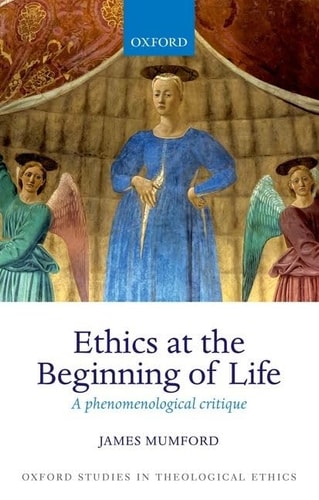
Ethics at the Beginning of Life: A Phenomenological Critique
0
0
As an Amazon Associate and affiliate partner, Menrva Books earns from qualifying purchases. Learn more
Author Description
Many of the most controversial moral decisions we face hinge upon competing descriptions of life, and never is this truer than at the beginning of life. James Mumford draws upon phenomenology (a branch of continental philosophy) to question the descriptive adequacy, the essential "purchase upon reality," of many of the approaches, attitudes and arguments which make up beginning of life ethics today. He argues that many of the most prevalent positions and practices in our late modern culture have simply failed to take into account the reality of human emergence, the particular way that new members of our species first appear in the world.Historically, phenomenologists have been far more interested in death than in birth. Mumford therefore first develops his own phenomenological investigation of human emergence, taking leads and developing approaches from phenomenologists both French and German, both living and dead. In the second half of the book phenomenology is finally applied to ethics, and acute moral questions are divided into two kinds: first those concerning "what" it is that we are dealing; and, secondly, the more contextual "where" questions relating to the situation in which the subject is found.Finally, although this book primarily constitutes a philosophical rather than a religious critique of contemporary ethics, with the findings from continental philosophy being brought to bear upon core convictions of English-speaking 'liberal' moral and political philosophers, Mumford concludes by exploring an alternative theological basis for human rights which might fill the vacuum created.
Menrva's Summary
THE THESIS
This work investigates whether contemporary ethical frameworks regarding the beginning of life possess sufficient descriptive adequacy to account for the reality of human emergence. James Mumford, a scholar in theological ethics, utilizes the tools of continental phenomenology to challenge the prevailing moral and political arguments in English-speaking liberal philosophy. By shifting the focus from the traditional preoccupation with death to the neglected phenomenon of birth, the author argues that current practices fail to grasp the essential nature of how new human life appears in the world.
THE SCOPE MAP
What You Will Find
- A phenomenological investigation into the nature of human emergence and birth.
- A critical analysis of contemporary liberal moral and political philosophy.
- A bifurcated ethical framework categorizing moral questions into 'what' (ontological) and 'where' (contextual) inquiries.
- An exploration of theological foundations for human rights as an alternative to secular vacuums.
THE AUTHORITY PERSPECTIVE
Scholars in the field of theological ethics recognize this text as a rigorous attempt to bridge the gap between continental philosophy and analytic moral discourse. Readers frequently note the academic density of the prose, which requires a foundational understanding of phenomenological terminology to fully grasp the author's critique.
Page Count:
240
Publication Date:
2015-08-30
Publisher:
Oxford University Press
ISBN-10:
0198745052
ISBN-13:
9780198745051
Philosophy
Bioethics
Ethics
Theology
Phenomenology
Life
Community Tags
Similar Books