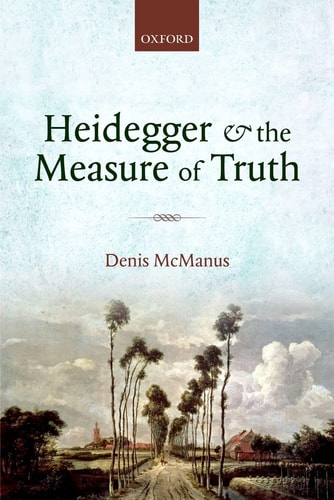
Heidegger and the Measure of Truth: Themes from his Early Philosophy
0
0
As an Amazon Associate and affiliate partner, Menrva Books earns from qualifying purchases. Learn more
Author Description
Denis McManus presents a new interpretation of Heidegger's early vision of our subjectivity and of the world we inhabit. Heidegger's "fundamental ontology" allows us to understand the creature that thinks as also one which acts, moves, even touches the world around it, a creature at home in the same ordinary world in which we too live our lives when outside of the philosophical closet; it also promises to free us from seemingly intractable philosophical problems, such as scepticism about the external world and other minds. But many of the concepts central to that vision are elusive; and some of the most widely accepted interpretations of Heidegger's vision harbour within themselves deep and important unclarities, while others foist upon us hopeless species of idealism. Drawing on an examination of Heidegger's work throughout the 1920s, Heidegger and the Measure of Truth offers a new way of understanding that vision. Central is the proposal that propositional thought presupposes what might be called a "measure," a mastery of which only a recognizably "worldly" subject can possess. McManus shows how these ideas emerge through Heidegger's engagement with the history of philosophy and theology, and sets out a novel reading of key elements in the fundamental ontology, including Heidegger's concept of "Being-in-the-world," his critique of scepticism, his claim to disavow both realism and idealism, and his difficult reflections on the nature of truth, science, authenticity, and philosophy itself. According to this reading, Heidegger's central claims identify genuine demands that we must meet if we are to achieve the feat of thinking determinate thoughts about the world around us.
Menrva's Summary
THE THESIS
This book investigates the core question of how Heidegger’s early fundamental ontology provides a coherent account of human subjectivity and truth without succumbing to the pitfalls of traditional realism or idealism. Denis McManus, a scholar of modern European philosophy, utilizes a rigorous examination of Heidegger’s writings from the 1920s to challenge prevailing interpretations. He argues that propositional thought relies on a foundational 'measure' of worldly engagement, which allows for a more grounded understanding of human existence and the nature of truth.
THE SCOPE MAP
What You Will Find
- An analysis of Heidegger’s fundamental ontology during the 1920s.
- A detailed examination of the concept of 'Being-in-the-world' and its implications for subjectivity.
- A critical review of Heidegger’s engagement with historical philosophy and theology.
- A novel framework for addressing skepticism regarding the external world and other minds.
THE AUTHORITY PERSPECTIVE
Scholars and students of phenomenology frequently note the high level of academic density and conceptual rigor present in this text. Experts highlight this work as a significant contribution to the ongoing debate regarding Heidegger’s stance on realism and the nature of truth.
Page Count:
272
Publication Date:
2016-03-01
Publisher:
Oxford University Press
ISBN-10:
0198748124
ISBN-13:
9780198748120
Philosophy
Continental Philosophy
Phenomenology
Metaphysics
Ontology
Epistemology
Community Tags
Similar Books