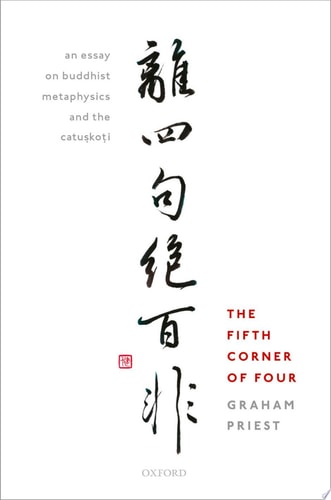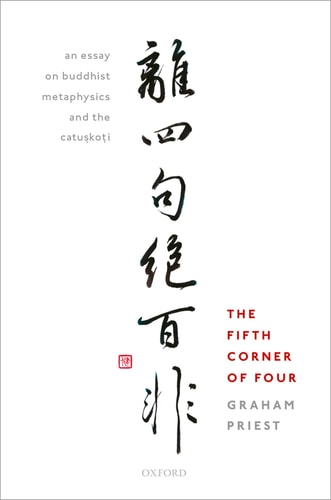
The Fifth Corner of Four: An Essay on Buddhist Metaphysics and the Catuṣkoṭi
0
0
As an Amazon Associate and affiliate partner, Menrva Books earns from qualifying purchases. Learn more
Author Description
Graham Priest presents an exploration of Buddhist metaphysics, drawing on texts which include those of Nãgãrjuna and Dõgen. The development of Buddhist metaphysics is viewed through the lens of the catuṣkoṭi. At its simplest, and as it appears in the earliest texts, this is a logical/ metaphysical principle which says that every claim is true, false, both, or neither; but the principle itself evolves, assuming new forms, as the metaphysics develops. An important step in the evolution incorporates ineffability. Such things make no sense from the perspective of a logic which endorses the principles of excluded middle and non-contradiction, which are standard fare in Western logic. However, the book shows how one can make sense of them by applying the techniques of contemporary non-classical logic, such as those of First Degree Entailment, and Plurivalent Logic. An important issue that emerges as the book develops is the notion of non-duality and its transcendence. This allows many of the threads of the book to be drawn together at its end. All matters are explained, in as far as possible, in a way that is accessible to those with no knowledge of Buddhist philosophy or contemporary non-classical logic.
Menrva's Summary
THE THESIS
This book investigates the logical and metaphysical implications of the Buddhist catuṣkoṭi, or four-cornered logic, and its evolution through historical texts. Graham Priest, a prominent logician, utilizes his expertise in non-classical logic to bridge the gap between Eastern philosophical traditions and Western analytical frameworks. By examining the works of thinkers such as Nāgārjuna and Dōgen, the author argues that the apparent contradictions within Buddhist metaphysics can be rendered coherent through the application of contemporary logical systems like First Degree Entailment and Plurivalent Logic.
THE SCOPE MAP
What You Will Find
- An analysis of the catuṣkoṭi principle across early and later Buddhist texts.
- Applications of non-classical logic to explain concepts of ineffability and non-duality.
- A comparative study between Western principles of excluded middle and Buddhist metaphysical structures.
- A synthesis of how these logical frameworks resolve complex philosophical problems regarding transcendence.
THE AUTHORITY PERSPECTIVE
Experts recognize this work as a significant contribution to the field of comparative philosophy, particularly for its ability to formalize traditionally elusive Buddhist concepts. Readers frequently note the academic density of the prose, though the author maintains a commitment to accessibility for those without prior training in logic or Eastern philosophy.
Page Count:
208
Publication Date:
2019-01-01
Publisher:
Oxford University Press
ISBN-10:
0198758715
ISBN-13:
9780198758716
Non-Fiction
Philosophy
Metaphysics
Buddhist Philosophy
Buddhism
Logic