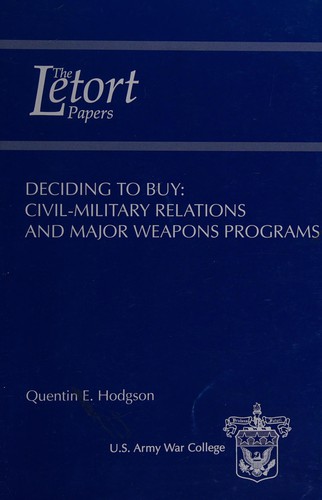
Deciding to Buy
0
0
As an Amazon Associate and affiliate partner, Menrva Books earns from qualifying purchases. Learn more
Author Description
The development and procurement of major weapons programs in the United States is a complex and often drawn-out process complicated by political considerations and often sharp disagreements over requirements and the merits of systems. Secretaries of Defense since Robert McNamara have sought to impose discipline on the process, with varying degrees of success. Conflicts between a Military Service and the civilian leadership are inevitable. A Service wants to develop the most advanced system to address its perceived need, whereas the Secretary of Defense must balance competing requirements across the Department of Defense. The military and the civilian leadership may also have different strategic perspectives that feed this conflict. Through the detailed analysis of three case studies—the Nuclear Surface Navy in the 1960s, the B-1 Bomber in the 1970s, and the Crusader Artillery System in the 2000s--the author explores some of the common themes and sources of friction that arise in civil-military relations concerning major weapons programs. He concludes with some thoughts on how the Secretary of Defense can anticipate and reduce these sources of friction, while retaining an environment that supports healthy debate.
Menrva's Summary
THE THESIS
The development and procurement of major weapons programs in the United States is a complex and often drawn-out process complicated by political considerations and often sharp disagreements over requirements and the merits of systems. Secretaries of Defense since Robert McNamara have sought to impose discipline on the process, with varying degrees of success. This book explores the inevitable conflicts between military services seeking advanced systems and civilian leadership balancing competing requirements and strategic perspectives. Through detailed analysis of three case studies—the Nuclear Surface Navy in the 1960s, the B-1 Bomber in the 1970s, and the Crusader Artillery System in the 2000s—the author examines common themes and sources of friction in civil-military relations concerning major weapons programs.
THE SCOPE MAP
- Analysis of the development and procurement of major US weapons programs.
- Exploration of conflicts between military services and civilian leadership.
- Detailed case studies: Nuclear Surface Navy (1960s), B-1 Bomber (1970s), Crusader Artillery System (2000s).
- Identification of common themes and sources of friction in civil-military relations.
- Author's conclusions on how Secretaries of Defense can anticipate and reduce friction while supporting healthy debate.
THE AUTHORITY PERSPECTIVE
This book offers a detailed analysis of the intricate and often contentious process of major weapons procurement in the United States, drawing on historical case studies to illustrate recurring points of friction between military services and civilian leadership. The author, Quentin E. Hodgson, leverages his expertise to dissect these complex civil-military dynamics. The work aims to provide insights into managing these conflicts and fostering a more productive environment for defense decision-making.
Page Count:
126
Publication Date:
2010-01-01
ISBN-10:
1584874678
Art
Non-Fiction
History
Military History
Civil-military relations
Community Tags
Similar Books