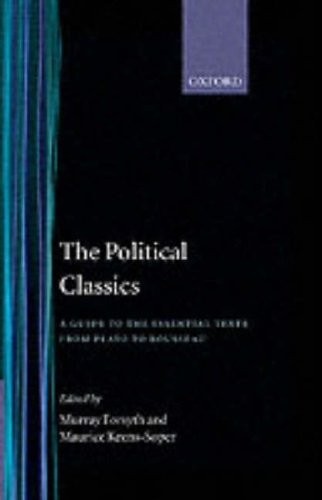
The Political Classics: Hamilton to Mill: v.2: Hamilton to Mill
0
0
As an Amazon Associate and affiliate partner, Menrva Books earns from qualifying purchases. Learn more
Author Description
This study of seven classic texts is designed to enable students of political ideas to gain a full appreciation of the great works which form the foundation of the subject. The texts - Hamilton's The Federalist, Sieyes' What is the Third Estate?, Burke's Reflections on the Revolution in France, Hegel's The Philosophy of Right, de Tocqueville's Democracy in America, Marx and Engels' Communist Manifesto, and Mill's On Liberty - illustrate and express the main themes of the critical period from the turbulent era of the American and French Revolutions through to the calmer waters of the nineteenth century: the growing distinction between state and society, the interplay of revolution and reaction, the growth of representative government, and the challenge posed by democracy.
Menrva's Summary
THE THESIS
This volume investigates the foundational texts of modern political thought to determine how they shaped the evolution of statecraft and societal structures from the late eighteenth to the nineteenth century. The authors, John Hoffman, Maurice Keens-Soper, and Murray Forsyth, provide a structured analysis of seven seminal works, examining how these writings articulate the transition from revolutionary upheaval to the establishment of representative governance. By contextualizing these texts within their respective historical periods, the authors argue that these works remain essential for understanding the ongoing tension between state authority and individual liberty.
THE SCOPE MAP
What You Will Find
- Analysis of seven classic political texts including works by Hamilton, Sieyes, Burke, Hegel, de Tocqueville, Marx, Engels, and Mill.
- Examination of core themes such as the distinction between state and society, the dynamics of revolution, and the development of representative government.
- Historical contextualization of political philosophy from the American and French Revolutions through the nineteenth century.
- Methodological approach to reading and interpreting complex political treatises for academic study.
THE AUTHORITY PERSPECTIVE
Experts frequently cite this volume as a reliable pedagogical tool for students navigating the complexities of canonical political theory. Readers often note the clarity of the prose, which makes dense philosophical arguments accessible without sacrificing academic rigor.
Page Count:
256
Publication Date:
1993-07-22
Publisher:
Oxford University Press
ISBN-10:
0198780257
ISBN-13:
9780198780250
History
Philosophy
Non-Fiction
Political Theory
Community Tags
Similar Books