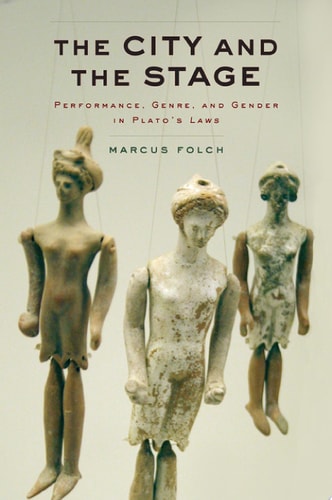
The City and the Stage: Performance, Genre, and Gender in Plato's Laws
0
0
As an Amazon Associate and affiliate partner, Menrva Books earns from qualifying purchases. Learn more
Author Description
What role did poetry, music, song, and dance play in the social and political life of the ancient Greek city? How did philosophy respond to, position itself against, and articulate its own ambitions in relation to the poetic tradition? How did ancient philosophers theorize and envision alternatives to fourth-century Athenian democracy? The City and the Stage poses such questions in a study of the Laws, Plato's last, longest, and unfinished philosophical dialogue. Reading the Laws in its literary, historical, and philosophical contexts, this book offers a new interpretation of Plato's final dialogue with the Greek poetic tradition and an exploration of the dialectic between philosophy and mimetic art. Although Plato is often thought hostile to poetry and famously banishes mimetic art from the ideal city of the Republic, The City and the Stage shows that in his final work Plato made a striking about-face, proposing to rehabilitate Athenian performance culture and envisaging a city, Magnesia, in which poetry, music, song, and dance are instrumental in the cultivation of philosophical virtues. Plato's views of the performative properties of music, dance, and poetic language, and the psychological underpinnings of aesthetic experience receive systematic treatment in this book for the first time. The social role of literary criticism, the power of genres to influence a society and lead to specific kinds of constitutions, performance as a mechanism of gender construction, and the position of women in ancient Greek performance culture are central themes throughout this study. A wide-ranging examination of ancient Greek philosophy and fourth-century intellectual culture, The City and the Stage will be of significance to anyone interested in ancient Greek literature, performance, and Platonic philosophy in its historical contexts.
Menrva's Summary
THE THESIS
This book investigates how Plato’s final dialogue, the Laws, reevaluates the role of poetry, music, and performance within the structure of an ideal city. Marcus Folch, a scholar of ancient Greek literature and philosophy, utilizes historical context and textual analysis to argue that Plato shifts from the exclusionary stance found in the Republic to a model where performance culture is integrated into the cultivation of civic virtue. The work examines the dialectic between philosophical governance and the mimetic arts to demonstrate how Plato envisioned these cultural forms as tools for social and political stability.
THE SCOPE MAP
What You Will Find
- Analysis of Plato's Laws as a blueprint for the city of Magnesia
- Examination of the psychological impact of music, dance, and poetic language
- Investigation of gender construction through performance in ancient Greece
- Discussion on the intersection of literary criticism and political constitution
Scope Limits
- The study focuses primarily on the Laws and does not provide a comprehensive survey of all Platonic dialogues
- The analysis is restricted to the context of fourth-century Athenian intellectual culture
THE AUTHORITY PERSPECTIVE
Scholars recognize this text as a significant contribution to the study of Plato's later political thought and his evolving relationship with the arts. Readers frequently note the academic density of the prose, which is intended for those with a background in classical philosophy or performance studies.
Page Count:
400
Publication Date:
2015-01-01
Publisher:
Oxford University Press
ISBN-10:
0190606487
ISBN-13:
9780190606480
History
Philosophy
Literary Criticism
Theatre
Political Theory
Greek drama
Humanities
Special Topics
Ancient History
Performance Studies
Plato
History & Surveys
Community Tags
Similar Books