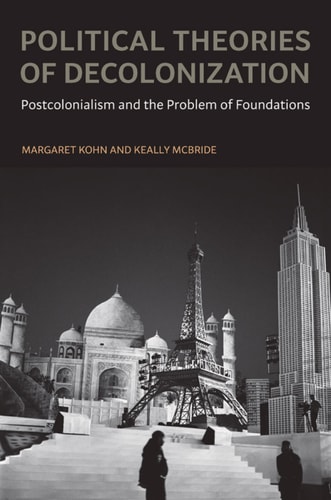
Political Theories of Decolonization: Postcolonialism and the Problem of Foundations
0
0
As an Amazon Associate and affiliate partner, Menrva Books earns from qualifying purchases. Learn more
Author Description
Political Theories of Decolonization provides an introduction to some of the seminal texts of postcolonial political theory. The difficulty of founding a new regime is an important theme in political theory, and the intellectual history of decolonization provides a rich--albeit overlooked--opportunity to explore it. Many theorists have pointed out that the colonized subject was a divided subject. This book argues that the postcolonial state was a divided state. While postcolonial states were created through the struggle for independence, they drew on both colonial institutions and reinvented pre-colonial traditions. Political Theories of Decolonization illuminates how many of the central themes of political theory such as land, religion, freedom, law, and sovereignty are imaginatively explored by postcolonial thinkers. In doing so, it provides readers access to texts that add to our understanding of contemporary political life and global political dynamics.
Menrva's Summary
THE THESIS
This book investigates the fundamental challenge of establishing stable political regimes within the context of postcolonial states. Authors Keally McBride and Margaret Kohn examine the intellectual history of decolonization to argue that postcolonial states are inherently divided entities. By analyzing how these nations synthesized colonial institutional legacies with reinvented pre-colonial traditions, the authors provide a framework for understanding the complexities of sovereignty and governance in the wake of imperial collapse.
THE SCOPE MAP
What You Will Find
- Analysis of seminal texts in postcolonial political theory
- Examination of core political concepts including land, religion, freedom, law, and sovereignty
- Comparative study of institutional inheritance versus indigenous tradition
Scope Limits
- The text focuses primarily on political theory rather than a comprehensive historical account of specific independence movements
- It does not provide an exhaustive survey of every postcolonial nation-state
THE AUTHORITY PERSPECTIVE
Scholars and students of political science frequently identify this work as a valuable introduction to the intersection of postcolonial thought and classical political theory. Experts highlight the text for its ability to bridge the gap between historical decolonization processes and contemporary global political dynamics.
Page Count:
224
Publication Date:
2011-01-01
Publisher:
Oxford University Press
ISBN-10:
0190453354
ISBN-13:
9780190453350
History
Decolonization
Political Theory
Community Tags
Similar Books