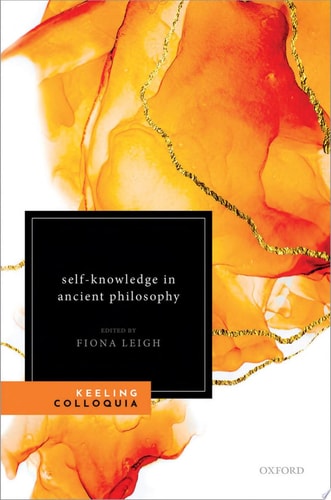
Self-Knowledge in Ancient Philosophy: The Eighth Keeling Colloquium in Ancient Philosophy
0
0
As an Amazon Associate and affiliate partner, Menrva Books earns from qualifying purchases. Learn more
Author Description
Self-knowledge - a person's knowledge of their own thoughts, character, and psychological states - has long been a central focus of philosophical enquiry. The concerns which occupy ancient thinkers with regard to self-knowledge, however, diverge in critical ways from contemporary investigations on the topic. In this volume, based upon the eighth Keeling Colloquium in Ancient Philosophy, leading scholars explore the treatment of self-knowledge in ancient Greek thought, particularly in Plato, Aristotle, Hellenistic thinkers, and Plotinus. A number of chapters identify specific modes of self-knowledge in ancient thought, such as knowledge of one's individual moral or political character in Plato, or one's own discursive thought as compared to that arising from the self-presence of intellect in Plotinus. Others identify interesting points of convergence with contemporary thinking to make interventions in existing debates as well as to articulate new research questions, such as whether Plato regarded self-knowledge as synoptic and diachronic in the Republic, or whether self-knowledge is a condition on virtue for Aristotle. By exploring the distinctions between the fundamental assumptions and conceptual frameworks in which ancient and modern philosophers examine self-knowledge, this volume makes a novel contribution to current scholarship in the field.
Menrva's Summary
THE THESIS
This volume investigates the divergence between ancient and contemporary conceptualizations of self-knowledge through a rigorous examination of Greek philosophical traditions. Editor Fiona Leigh compiles contributions from leading scholars who analyze how thinkers such as Plato, Aristotle, and Plotinus approached the understanding of one's own psychological states, moral character, and intellectual presence. The text utilizes historical analysis to challenge modern assumptions, arguing that ancient frameworks offer distinct insights that remain relevant to current philosophical discourse.
THE SCOPE MAP
What You Will Find
- Comparative analysis of self-knowledge in Plato, Aristotle, Hellenistic philosophy, and Plotinus
- Examination of the relationship between self-knowledge and virtue ethics
- Discussion of diachronic and synoptic models of self-awareness
- Critical interventions in contemporary debates regarding consciousness and self-presence
THE AUTHORITY PERSPECTIVE
Scholars and students of classical philosophy identify this collection as a significant resource for understanding the evolution of epistemological inquiry. The text is noted for its academic density and its ability to bridge the gap between historical exegesis and modern philosophical problems.
Page Count:
272
Publication Date:
2020-05-12
Publisher:
Oxford University Press
ISBN-10:
0198786069
ISBN-13:
9780198786061
Philosophy
Epistemology
Ethics
Academic
Community Tags
Similar Books