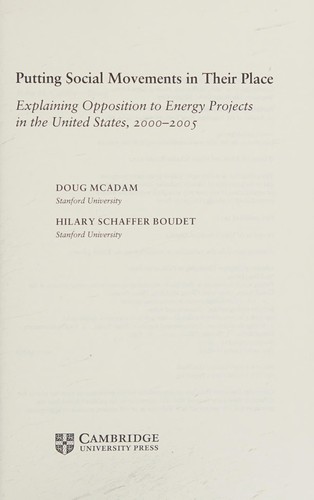
Putting Social Movements in Their Place
0
0
As an Amazon Associate and affiliate partner, Menrva Books earns from qualifying purchases. Learn more
Author Description
This book reports the results of a comparative study of 20 communities earmarked for environmentally risky energy projects. The authors find the overall level of emergent opposition to the projects very low, and they seek to explain that variation and impact it had on the proposed projects. The field of social movement studies has expanded dramatically over the past three decades. But as it has done so, its focus has become increasingly narrow and,źmovement-centric.,Ź When combined with the tendency to select successful struggles for study, the conceptual and methodological conventions of the field conduce to a decidedly Ptolemaic view of social movements: one that exaggerates the frequency and causal significance of movements as a form of politics. This book reports the results of a comparative study, not of movements, but of 20 communities earmarked for environmentally risky energy projects. In stark contrast to the central thrust of the social movement literature, the authors find that the overall level of emergent opposition to the projects to have been very low, and they seek to explain that variation and the impact, if any, it had on the ultimate fate of the proposed projects.
Menrva's Summary
THE THESIS
This book investigates why some communities resist environmentally risky energy projects while others do not. The authors present a comparative study of 20 such communities, challenging the prevailing social movement literature's tendency to focus on successful movements and exaggerate their causal significance. They find that emergent opposition to these projects is surprisingly low and aim to explain the variation in resistance and its impact on project outcomes.
THE SCOPE MAP
- A comparative analysis of 20 communities facing environmentally risky energy projects.
- An examination of factors influencing the level of emergent opposition to these projects.
- An assessment of the impact of community opposition on the fate of proposed energy projects.
- A critique of the social movement studies field's focus on successful movements and its 'movement-centric' view.
THE AUTHORITY PERSPECTIVE
The book challenges conventional wisdom in social movement studies by presenting data that contradicts the field's typical focus on successful movements. By examining communities with low levels of opposition, it offers a counterpoint to the literature's tendency to overemphasize the frequency and significance of social movements. The study's comparative approach and focus on environmental projects provide a unique perspective on community-level responses to development.
Page Count:
0
Publication Date:
2012-01-01
ISBN-10:
1107020662
ISBN-13:
9781107020665
Non-Fiction
History
Politics
Science
Sociology
Community Studies