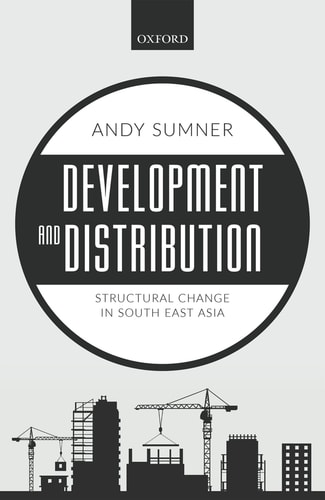
Development and Distribution: Structural Change in South East Asia
0
0
As an Amazon Associate and affiliate partner, Menrva Books earns from qualifying purchases. Learn more
Author Description
Since the Second World War, surprisingly few developing countries have experienced a truly sustained episode of economic and social convergence towards the structural characteristics of the advanced nations. East Asia has exceeded most regions in its achievement of convergence, and much has been written on comparative industrialization and development in North East Asia. Less discussed is South East Asia and the surprising and inclusive transformation several of its countries has undergone.Development and Distribution focuses on South East Asia and, more specifically, on Malaysia, Indonesia, and Thailand. These three nations have all undergone a major transformation - in a way never anticipated - from being poor, agrarian countries to middle-income countries with developed industrial and manufacturing bases. How did Malaysia, Indonesia, and Thailand achieve such a transformation, and how did they achieve the transformation with a form of economic growth that was driven by structural transformation, but that was 'inclusive'? Given that historically it has been thought that structural transformation tends to push up inequality, whilst inclusive growth necessitates static or even falling inequality, this last point is particularly salient to developing countries. Understanding how the transformation was possible in a relatively small space of time, the extent to which it was inclusive, and the caveats and prospects for South East Asia is thus an area of enquiry significant to all developing countries as they seek economic and social transformation.
Menrva's Summary
THE THESIS
This book investigates how Malaysia, Indonesia, and Thailand achieved rapid economic convergence and inclusive growth despite historical trends suggesting that structural transformation typically increases inequality. Andy Sumner, a prominent researcher in international development, utilizes comparative economic data and historical analysis to examine the specific policy frameworks and structural shifts that allowed these nations to transition from agrarian economies to middle-income industrial powers. The work argues that the Southeast Asian experience provides a unique model for understanding how developing nations can balance industrialization with social equity.
THE SCOPE MAP
What You Will Find
- Comparative analysis of economic development in Malaysia, Indonesia, and Thailand.
- Examination of the relationship between structural transformation and income inequality.
- Evaluation of industrial and manufacturing base expansion since the Second World War.
- Assessment of the prospects and limitations for inclusive growth in developing economies.
THE AUTHORITY PERSPECTIVE
Experts in development economics recognize this text as a significant contribution to the study of Southeast Asian industrialization. Readers frequently note the academic rigor of the analysis, which provides a clear framework for understanding the divergence between regional growth patterns and global development trends.
Page Count:
240
Publication Date:
2018-09-26
Publisher:
Oxford University Press
ISBN-10:
0198792360
ISBN-13:
9780198792369
Economics
Thailand economic conditions
Malaysia
Southeast Asia
Indonesia
International relations
Community Tags
Similar Books