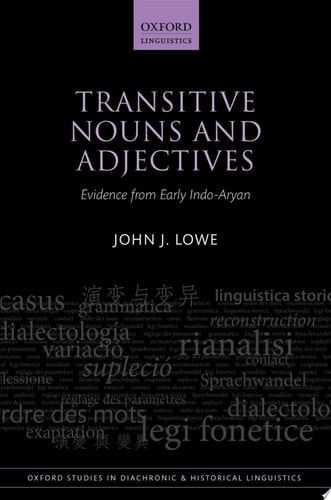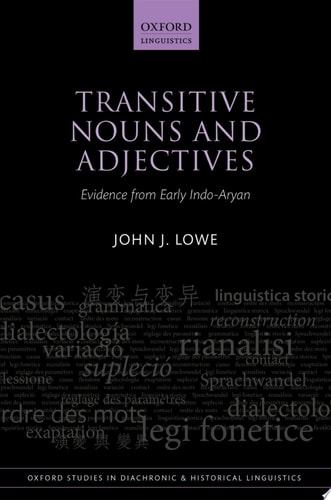
Transitive Nouns and Adjectives: Evidence from Early Indo-Aryan
0
0
As an Amazon Associate and affiliate partner, Menrva Books earns from qualifying purchases. Learn more
Author Description
This book explores the wealth of evidence from early Indo-Aryan for the existence of transitive nouns and adjectives, a rare linguistic phenomenon which, according to some categorizations of word classes, should not occur. John Lowe shows that most transitive nouns and adjectives attested in early Indo-Aryan cannot be analysed as a type of non-finite verb category, but must be acknowledged as a distinct constructional type. The volume provides a detailed introduction to transitivity (verbal and adpositional), the categories of agent and action noun, and to early Indo-Aryan. Four periods of early Indo-Aryan are selected for study: Rigvedic Sanskrit, the earliest Indo-Aryan; Vedic Prose, a slightly later form of Sanskrit; Epic Sanskrit, a form of Sanskrit close to the standardized 'Classical' Sanskrit; and Pali, the early Middle Indo-Aryan language of the Buddhist scriptures. John Lowe shows that while each linguistic stage is different, there are shared features of transitive nouns and adjectives which apply throughout the history of early Indo-Aryan. The data is set in the wider historical context, from Proto-Indo-European to Modern Indo-Aryan, and a formal linguistic analysis of transitive nouns and adjectives is provided in the framework of Lexical-Functional Grammar.
Menrva's Summary
THE THESIS
This book investigates the linguistic validity and structural characteristics of transitive nouns and adjectives within the early Indo-Aryan language family. John J. Lowe, a specialist in historical linguistics, utilizes a robust corpus of early Indo-Aryan texts to challenge the traditional categorization of word classes. By applying the framework of Lexical-Functional Grammar, the author argues that these transitive forms constitute a distinct constructional type rather than mere non-finite verbal derivatives.
THE SCOPE MAP
What You Will Find
- A diachronic analysis spanning Rigvedic Sanskrit, Vedic Prose, Epic Sanskrit, and Pali.
- A formal linguistic methodology utilizing Lexical-Functional Grammar to categorize word classes.
- Comparative evidence tracing the evolution of transitivity from Proto-Indo-European to Modern Indo-Aryan.
- Detailed definitions and classifications of agent nouns, action nouns, and adpositional transitivity.
THE AUTHORITY PERSPECTIVE
Experts recognize this volume as a significant contribution to the study of Indo-Aryan syntax and historical morphology. Readers frequently note the high level of technical density, making it a specialized resource for advanced students and researchers in historical linguistics.
Page Count:
400
Publication Date:
2017-08-29
Publisher:
Oxford University Press
ISBN-10:
019879357X
ISBN-13:
9780198793571
Sanskrit
Linguistics
Historical linguistics
Grammar