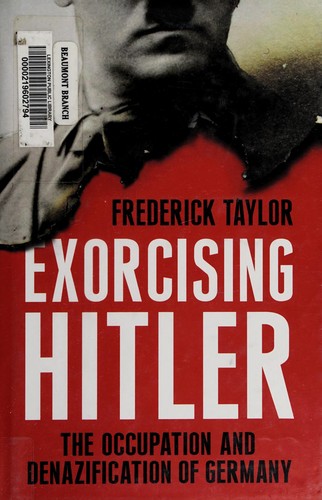
Exorcising Hitler
0
0
As an Amazon Associate and affiliate partner, Menrva Books earns from qualifying purchases. Learn more
Author Description
Not since the end of the Roman Empire, almost fifteen hundred years earlier, is there a parallel, in Europe at least, to the fall of the German nation in 1945. Industrious and inventive, home over centuries to a disproportionate number of western civilization's greatest thinkers, writers, scientists and musicians, Germany had entered the twentieth century united, prosperous, and strong, admired by almost all humanity for its remarkable achievements. During the 1930s, embittered by one lost war and then scarred by mass unemployment, Germany embraced the dark cult of National Socialism. Within less than a generation, its great cities lay in ruins and its shattered industries and cultural heritage seemed utterly beyond saving. The Germans themselves had come to be regarded as evil monsters. After six years of warfare how were the exhausted victors to handle the end of a horror that to most people seemed without precedent? In Exorcising Hitler, Frederick Taylor tells the story of Germany's year zero and what came after. As he describes the final Allied campaign, the hunting down of the Nazi resistance, the vast displacement of peoples in central and eastern Europe, the attitudes of the conquerors, the competition between Soviet Russia and the West, the hunger and near starvation of a once proud people, the initially naive attempt at expunging Nazism from all aspects of German life and the later more pragmatic approach, we begin to understand that despite almost total destruction, a combination of conservatism, enterprise and pragmatism in relation to former Nazis enabled the economic miracle of the 1950s. And we see how it was only when the '60s generation (the children of the Nazi era) began to question their parents with increasing violence that Germany began to awake from its 'sleep cure'.
Menrva's Summary
THE THESIS
The end of World War II left Germany in a state of unprecedented devastation and moral crisis. Frederick Taylor's Exorcising Hitler chronicles the complex and often contradictory process of Germany's reconstruction and denazification in the immediate post-war period. The book examines the Allied powers' initial attempts to purge Nazism, the vast displacement of populations, and the pragmatic decisions that ultimately paved the way for Germany's economic resurgence. It also explores the societal reckoning that occurred as the post-war generation began to confront their parents' past.
THE SCOPE MAP
- The state of Germany in 1945, following its total defeat in World War II.
- The Allied campaign and the pursuit of Nazi remnants.
- The massive displacement of peoples in Central and Eastern Europe.
- The differing attitudes and approaches of the victorious Allied powers.
- The competition and tensions between Soviet Russia and the Western Allies.
- The widespread hunger and near-starvation experienced by the German population.
- The initial idealistic efforts and later pragmatic strategies for expunging Nazism.
- The role of conservatism, enterprise, and pragmatism in the post-war economic recovery.
THE AUTHORITY PERSPECTIVE
In Exorcising Hitler, Frederick Taylor provides a comprehensive account of Germany's 'Year Zero' and its subsequent recovery. The book details the immense challenges faced by both the defeated Germans and the victorious Allies in the aftermath of World War II. Taylor's narrative highlights the complex interplay of political competition, societal needs, and ideological struggles that shaped Germany's path forward. The work is noted for its detailed examination of how pragmatism, particularly in dealing with former Nazis, contributed to the eventual economic miracle.
Page Count:
438
Publication Date:
2012-01-01
ISBN-10:
1408822121
ISBN-13:
9781408822128
Politics
Non-Fiction
Art
History
Social History
Community Tags
Similar Books