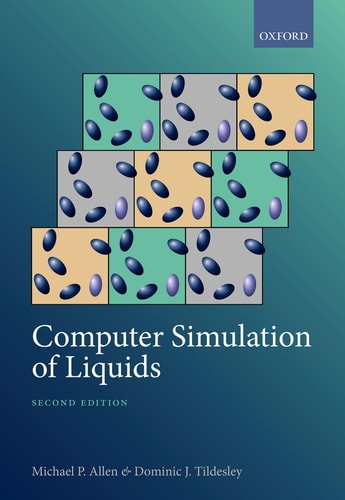
Computer Simulation of Liquids: Second Edition
0
0
As an Amazon Associate and affiliate partner, Menrva Books earns from qualifying purchases. Learn more
Author Description
This book provides a practical guide to molecular dynamics and Monte Carlo simulation techniques used in the modelling of simple and complex liquids. Computer simulation is an essential tool in studying the chemistry and physics of condensed matter, complementing and reinforcing both experiment and theory. Simulations provide detailed information about structure and dynamics, essential to understand the many fluid systems that play a key role in our daily lives: polymers, gels, colloidal suspensions, liquid crystals, biological membranes, and glasses. The second edition of this pioneering book aims to explain how simulation programs work, how to use them, and how to interpret the results, with examples of the latest research in this rapidly evolving field. Accompanying programs in Fortran and Python provide practical, hands-on, illustrations of the ideas in the text.
Menrva's Summary
THE THESIS
This text investigates the methodologies and practical applications of molecular dynamics and Monte Carlo simulations in the study of condensed matter. Authors Dominic J. Tildesley and Michael P. Allen provide a comprehensive framework for understanding fluid systems, drawing upon their extensive expertise in computational physics. The book argues that simulation is a critical bridge between theoretical models and experimental observation, offering a systematic approach to analyzing complex liquid structures.
THE SCOPE MAP
What You Will Find
- Detailed explanations of molecular dynamics and Monte Carlo simulation algorithms.
- Practical implementation guides for modeling simple and complex liquids.
- Accompanying source code in Fortran and Python for hands-on application.
- Analysis of diverse fluid systems including polymers, gels, and biological membranes.
THE AUTHORITY PERSPECTIVE
Experts recognize this work as a foundational text for researchers and students entering the field of computational chemistry. Readers frequently note the technical density of the prose, which serves as a rigorous reference for those developing and interpreting simulation programs.
Page Count:
640
Publication Date:
2017-08-22
Publisher:
Oxford University Press
ISBN-10:
0198803206
ISBN-13:
9780198803201
Science
Liquids
Physics
Computer Science
Chemistry
Community Tags
Similar Books