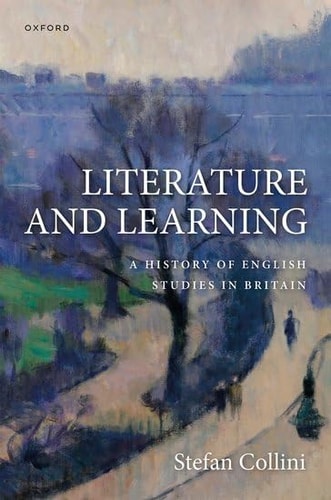
Literature and Learning: A History of English Studies in Britain
0
0
As an Amazon Associate and affiliate partner, Menrva Books earns from qualifying purchases. Learn more
Author Description
The study and teaching of English literature is generally regarded as one of the central disciplines in the modern university, yet for much of its history it struggled to gain academic legitimacy and was frequently derided as 'a soft option'. Its early professors responded by emphasizing its scholarly character, foregrounding philology and literary history in ways that marked the syllabus far into the twentieth century.Stefan Collini provides here the first full account of the discipline's development from its late-eighteenth-century beginnings up to the early 1960s. Paying special attention to institutional settings, he challenges numerous assumptions about the character of universities in the nineteenth and early twentieth centuries. From the detailed exploration of syllabuses, exam papers, and other institutional records, the impact of literary criticism is revealed to be later and more partial than is commonly assumed. Rather than seeing the early teaching of English literature as 'a substitute for religion' or 'a means to soften class conflict', Collini emphasizes the role of ideals of learnedness and scholarship, as well as of external factors such as opportunities for employment in the civil service and secondary school-teaching. There are full discussions of the parts played by such figures as John Churton Collins, A.C. Bradley, George Saintsbury, and Walter Raleigh, together with sceptical analyses of the decisive significance usually attributed to Matthew Arnold, T.S. Eliot, I.A. Richards, and F.R. Leavis. Separate chapters are devoted to neglected aspects of the story such as the role of Classics, the importance of the subject for women's higher education, and the connections with English teaching in schools.Drawing on extensive use of institutional archives and records as well as the writings of contemporary participants, the book offers a vivid and wide-ranging history of English-as-discipline and its centrality across academic, literary, cultural, and
Menrva's Summary
THE THESIS
This work investigates the historical development of English literature as an academic discipline within British universities, challenging established narratives regarding its origins and purpose. Stefan Collini, a distinguished historian of intellectual life, utilizes extensive archival research and institutional records to trace the evolution of the field from the late eighteenth century through the early 1960s. He argues against the common perception of English studies as a moral or social substitute for religion, instead positioning the discipline's growth within the context of professionalization, scholarly standards, and the practical demands of the civil service and secondary education.
THE SCOPE MAP
What You Will Find
- A detailed chronological history of English studies in Britain from the late 1700s to the 1960s.
- Analysis of institutional records, including exam papers and university syllabuses.
- Examination of the influence of key figures such as John Churton Collins, A.C. Bradley, and George Saintsbury.
- Exploration of the role of Classics and the impact of women's higher education on the discipline.
THE AUTHORITY PERSPECTIVE
Scholars and historians of education recognize this text as a definitive account that corrects long-standing myths about the formation of English departments. Readers frequently note the academic density of the prose and the meticulous nature of the archival research presented throughout the volume.
Page Count:
640
Publication Date:
2025-07-10
Publisher:
Oxford University Press
ISBN-10:
0198800185
ISBN-13:
9780198800187
History
Education Theory
Education
Literary Criticism
Academic History
Schools & Teaching
British History
Community Tags
Similar Books