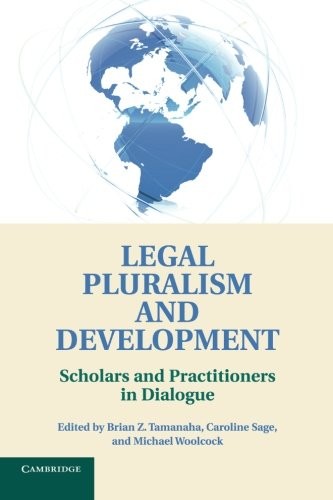
Legal Pluralism and Development
0
0
As an Amazon Associate and affiliate partner, Menrva Books earns from qualifying purchases. Learn more
Author Description
This book brings together contributions from academics and practitioners to explore the implications of legal pluralism for legal development"--"Previous efforts at legal development have focused almost exclusively on state legal systems, many of which have shown little improvement over time. Recently, organizations engaged in legal development activities have begun to pay greater attention to the implications of local, informal, indigenous, religious, and village courts or tribunals, which often are more efficacious than state legal institutions, especially in rural communities. Legal pluralism is the term applied to these situations because these institutions exist alongside official state legal systems, usually in a complex or uncertain relationship. Although academics, especially legal anthropologists and sociologists, have discussed legal pluralism for decades, their work has not been consulted in the development context. Similarly, academics have failed to benefit from the insights of development practitioners. This book brings together, in a single volume, contributions from academics and practitioners to explore the implications of legal pluralism for legal development. All of the practitioners have extensive experience in development projects, the academics come from a variety of backgrounds, and most have written extensively on legal pluralism and on development"--
Menrva's Summary
THE THESIS
This book investigates the efficacy of state legal systems versus informal legal institutions in development contexts. The author, Brian Z. Tamanaha, a distinguished legal scholar, draws upon decades of academic discussion on legal pluralism and integrates the practical experiences of development practitioners. The book examines situations where local, indigenous, religious, and village courts operate alongside official state legal systems, often proving more effective, particularly in rural areas. It aims to bridge the gap between academic theory and practical application in legal development initiatives.
THE SCOPE MAP
- Analysis of the limitations and failures of traditional state-centric legal development.
- Exploration of the concept of legal pluralism and its relevance to development.
- Case studies and insights from practitioners working on legal development projects.
- Examination of the complex and often uncertain relationships between state and non-state legal systems.
- Discussion on how to leverage the efficacy of informal legal institutions for better development outcomes.
THE AUTHORITY PERSPECTIVE
The book is positioned as a crucial bridge between academic discourse on legal pluralism and the practical challenges faced in legal development. By bringing together scholars and practitioners, it aims to inform development policy and practice. The work is likely to be of interest to academics in law, anthropology, and sociology, as well as to those involved in international development and governance. Its focus on the practical efficacy of informal legal systems suggests a pragmatic approach to understanding and improving legal frameworks in diverse contexts.
Page Count:
272
Publication Date:
2013-01-01
ISBN-10:
1107690900
ISBN-13:
9781107690905
Economics
Politics
Non-Fiction
Sociology
Law
Community Tags
Similar Books