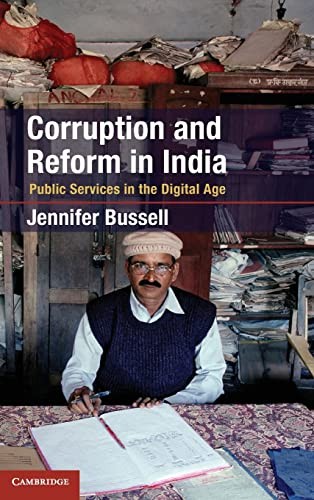
Corruption and Reform in India
0
0
As an Amazon Associate and affiliate partner, Menrva Books earns from qualifying purchases. Learn more
Author Description
This book asks why some governments improve public services more effectively than others. Through the investigation of a new era of administrative reform, in which digital technologies may be used to facilitate citizens' access to the state, Jennifer Bussell's analysis provides unanticipated insights into this fundamental question. In contrast to factors such as economic development or electoral competition, this study highlights the importance of access to rents, which can dramatically shape the opportunities and threats of reform to political elites. Drawing on a sub-national analysis of twenty Indian states, a field experiment, statistical modeling, case studies, interviews of citizens, bureaucrats and politicians, and comparative data from South Africa and Brazil, Bussell shows that the extent to which politicians rely on income from petty and grand corruption is closely linked to variation in the timing, management and comprehensiveness of reforms
Menrva's Summary
THE THESIS
This book investigates the reasons behind varying effectiveness in public service improvement across different governments. Jennifer Bussell's analysis, focusing on a new era of administrative reform utilizing digital technologies for citizen access, offers novel perspectives on this core issue. The study posits that beyond economic development or electoral competition, the availability of rents significantly influences political elites' receptiveness to reform. Through a multi-faceted approach encompassing sub-national analysis of twenty Indian states, a field experiment, statistical modeling, case studies, interviews, and comparative data from South Africa and Brazil, the book demonstrates a strong correlation between politicians' reliance on corruption and the nature of reforms undertaken.
THE SCOPE MAP
- Analysis of administrative reform and the role of digital technologies in citizen access to the state.
- Investigation into the impact of 'access to rents' on political elites' reform opportunities and threats.
- Sub-national analysis of twenty Indian states.
- Inclusion of a field experiment.
- Application of statistical modeling.
- Utilization of case studies, interviews with citizens, bureaucrats, and politicians.
- Comparative data from South Africa and Brazil.
THE AUTHORITY PERSPECTIVE
The book examines the dynamics of corruption and reform within governmental structures, particularly focusing on how political elites' financial incentives shape administrative changes. It posits that the degree to which politicians depend on income derived from corruption directly influences the implementation and scope of reforms. The research employs a rigorous methodology, combining quantitative analysis with qualitative insights from diverse sources across India and other nations. This approach allows for a nuanced understanding of the complex interplay between governance, technology, and political economy in developing contexts.
Page Count:
346
Publication Date:
2012-01-01
ISBN-10:
1107019052
ISBN-13:
9781107019058
Economics
Science
Politics
Non-Fiction
South Asia
Government
Public Administration
Community Tags
Similar Books