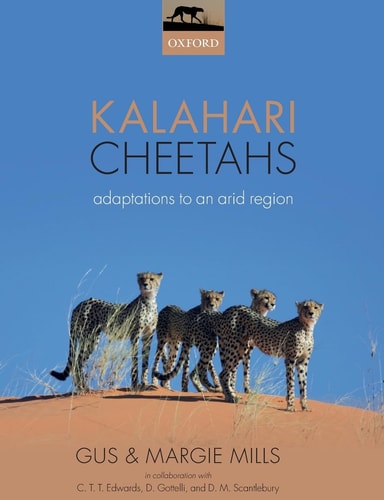
Kalahari Cheetahs: Adaptations to an Arid Region
0
0
As an Amazon Associate and affiliate partner, Menrva Books earns from qualifying purchases. Learn more
Author Description
The cheetah, the fastest terrestrial animal, has widespread appeal amongst wildlife biologists and enthusiasts alike. However, like all all large carnivores, it is increasingly threatened by habitat loss and its status is now classified as 'Vulnerable' by the IUCN. This is the first comprehensive study of cheetah biology in an arid environment, a major component of its current distribution range. The book brings together results from an intensive six year study of the cheetah by the authors in the Kgalagadi Transfrontier Park in South Africa and Botswana. It documents a wealth of detailed and direct observations of cheetah population biology and behavioural ecology, adopting an evolutionary approach and providing a conceptual framework for future research and applied management in the context of global environmental change.Kalahari Cheetahs covers topics such as optimal foraging theory, hunting strategies and predator prey relations, mating systems and reproductive strategies and success, inter-specific competition, demography, social organisation, and population limitation. Comparisons with previous cheetah studies reveal the variability of ecological determinants on behaviour, and the behavioural flexibility and ability of these carnivores to adapt to different environments.This advanced textbook is suitable for graduate level students as well as professional researchers in felid behavioural ecology and conservation biology. It will also be of relevance and use to conservationists, wildlife managers, and African wildlife enthusiasts.
Menrva's Summary
THE THESIS
This book investigates how the cheetah adapts its behavioral ecology and population dynamics to survive within the challenging, arid environment of the Kalahari. Authors Gus and Margaret Mills utilize data from an intensive six-year field study conducted in the Kgalagadi Transfrontier Park to construct a comprehensive framework for understanding felid survival. By applying evolutionary theory to their observations, the authors provide a rigorous analysis of how environmental constraints dictate the life history and social organization of this vulnerable predator.
THE SCOPE MAP
What You Will Find
- Detailed analysis of optimal foraging theory and hunting strategies in arid landscapes.
- Examination of mating systems, reproductive success, and population demography.
- Comparative data sets contrasting Kalahari cheetah populations with those in other environments.
- Methodologies for predator-prey interaction studies and applied conservation management.
THE AUTHORITY PERSPECTIVE
Experts recognize this work as a foundational text for graduate-level research in felid behavioral ecology and conservation biology. Readers frequently note the academic density of the prose and the value of the authors' long-term field observations for professional wildlife management.
Page Count:
224
Publication Date:
2018-09-24
Publisher:
Oxford University Press
ISBN-10:
0198815565
ISBN-13:
9780198815563
Science
Biology
Ecology
Zoology
Wildlife
Conservation
Cheetah
Deserts
Community Tags
Similar Books