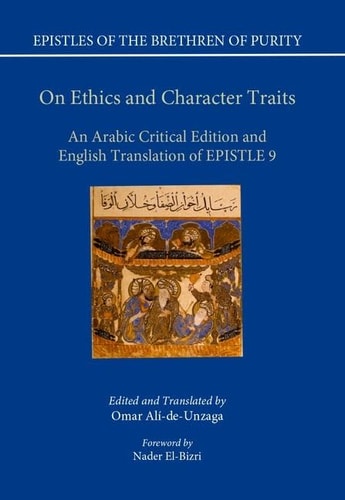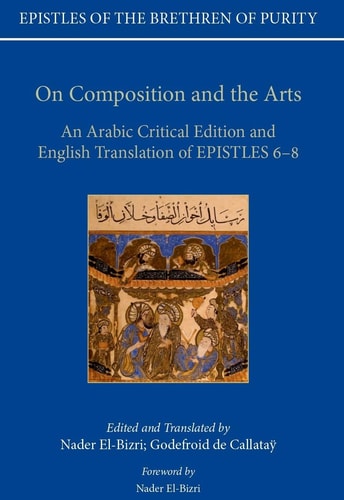
On Composition and the Arts: An Arabic Critical Edition and English Translation of Epistles 6-8
0
0
As an Amazon Associate and affiliate partner, Menrva Books earns from qualifying purchases. Learn more
Author Description
The Brethren of Purity, the anonymous adepts of a tenth-century esoteric fraternity based in Basra and Baghdad, hold an eminent position in the history of science and philosophy in Islam due to the wide reception and assimilation of their monumental encyclopaedia, the Epistles of the Brethren of Purity. This compendium contains fifty-two epistles offering synoptic accounts of the classical sciences and philosophies of the age; divided into four classificatory parts, it treats themes in mathematics, logic, natural philosophy, psychology, metaphysics, and theology, in addition to didactic fables.Epistles 6 to 8 are from the first division of the Epistles, on the propaedeutical and mathematical sciences. Epistle 6 develops ideas concerning natural numbers and their arithmetic, geometric, and harmonic ratios, marked by the influence of Nicomachus of Gerasa and of Euclid. The Brethren here emphasize practical applications of proportionality in music, medicine, and alchemy. Epistle 7 addresses theoretical scientific knowledge as directed towards the spiritual realities of souls, the goal of which is to actualize human potential; this epistle also presents a remarkable classification of sciences. Epistle 8 surveys material cultures in the Islamic mediaeval milieu, embellished by a consideration of the effects of the heavenly bodies on the predisposition of individuals to follow specific trades. These three epistles are, of course, underpinned by the Brethren's perennial tropes of the microcosm/macrocosm analogy and the emanative hierarchy of existents.
Menrva's Summary
THE THESIS
This volume investigates the foundational mathematical and philosophical frameworks of the tenth-century Ikhwan al-Safa, or Brethren of Purity, through a critical edition and translation of three specific epistles. Godefroid de Callatay, a scholar specializing in the intellectual history of the medieval Islamic world, provides a rigorous analysis of these texts to elucidate how the Brethren synthesized classical Greek scientific traditions with their own esoteric, emanative worldview. By examining the intersection of arithmetic, music, and material culture, the author argues that these epistles serve as a vital bridge between ancient Hellenistic knowledge and the development of medieval Islamic intellectual thought.
THE SCOPE MAP
What You Will Find
- A critical bilingual edition of Epistles 6, 7, and 8 from the Ikhwan al-Safa encyclopaedia.
- Analysis of the mathematical foundations of arithmetic, geometry, and harmonic ratios derived from Nicomachus and Euclid.
- Examination of the relationship between material culture, trade, and the influence of celestial bodies on human predisposition.
- A detailed exploration of the Brethren's classification of sciences and their focus on the spiritual actualization of human potential.
THE AUTHORITY PERSPECTIVE
Scholars recognize this work as a significant contribution to the study of the Ikhwan al-Safa, providing necessary access to primary source material for researchers in the history of science and philosophy. The text is noted for its high academic rigor and its ability to contextualize complex medieval concepts for contemporary readers.
Page Count:
326
Publication Date:
2018-04-01
Publisher:
Oxford University Press
ISBN-10:
0198816928
ISBN-13:
9780198816928
Philosophy
Iran
Islamic Studies
Ikhwan Al-safa
Classical Philosophy
Mathematics
Community Tags
Similar Books