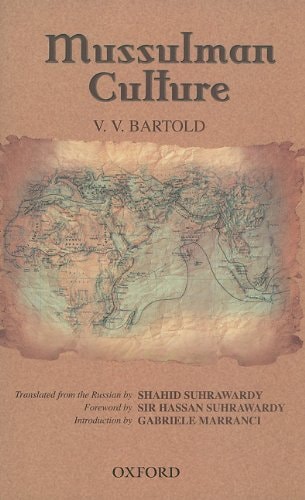
Mussulman Culture
0
0
As an Amazon Associate and affiliate partner, Menrva Books earns from qualifying purchases. Learn more
Author Description
The greatest impact of Islam on history has been cultural; however this aspect of Islamic history has been neglected in comparison to political and judicial history. Russian historian V.V. Bartold, was one of the first scholars to project Muslim culture, and in his work gave primacy to clarity and the organization of knowledge. He posits the position of Islam in world history to the position of Christianity as a cultural force in both the Roman and the eastern worlds. Bartold's Russian vantage helped to make him a unique specialist on Islam in Central Asia, as he encouraged the Abbasid and post-Abbasid Mulsim cultures to fine their proper place in history. The Mongol invasion is not treated merely as destruction and disruption of Muslim culture, but also as a factor which affected late medieval culture. Most of the great exponents of Muslim culture such as Ibn Khaldun and Avicenna are covered. Bartold concludes with remarking on the effect the passing of cultural leadership from the East to the West had on his own native Russia. This monograph is remarkable for retaining its relevance and validity after almost a whole century and a host of intervening specialized works in the intervening period. This work was translated four years after the author's death by Shahid Suhrawardy, an eminent scholar in his own right, and the foreword has been written by Sir Hassan Suhrawady, then Vice-Chancellor of the Calcutta University.
Menrva's Summary
THE THESIS
This work investigates the historical trajectory and cultural contributions of Islamic civilization, arguing that its intellectual and social impact is as significant as its political and judicial history. Russian historian V.V. Bartold utilizes his unique vantage point on Central Asian history to contextualize the development of Muslim culture from the Abbasid period through the Mongol invasions. By comparing the cultural influence of Islam to that of Christianity in the Roman and eastern worlds, the author provides a structured framework for understanding the evolution of knowledge and leadership in the medieval period.
THE SCOPE MAP
What You Will Find
- Analysis of Abbasid and post-Abbasid cultural developments.
- Examination of the Mongol invasion as a transformative factor in late medieval culture.
- Biographical and intellectual assessments of key figures such as Ibn Khaldun and Avicenna.
- Comparative study of cultural leadership shifts between the East and the West.
THE AUTHORITY PERSPECTIVE
Scholars and historians frequently highlight this monograph as a foundational text that maintains its analytical relevance nearly a century after its initial publication. Readers often note the clarity and systematic organization of knowledge that distinguishes Bartold's approach to complex historical transitions.
Page Count:
95
Publication Date:
2010-02-28
Publisher:
Oxford University Press
ISBN-10:
0195476700
ISBN-13:
9780195476705
Non-Fiction
History
Islamic Studies
Iran
Cultural History
Community Tags
Similar Books