
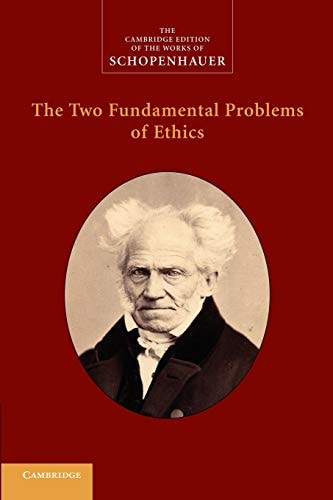
The Two Fundamental Problems of Ethics
0
0
As an Amazon Associate and affiliate partner, Menrva Books earns from qualifying purchases. Learn more
Author Description
'my philosophy is like Thebes with a hundred gates: one can enter from all sides and through each gate arrive at the direct path to the centre' Schopenhauer's two essays On the Freedom of the Will and On the Basis of Morals form his complete system of ethics. Their doctrines, continuous with those in his major work The World as Will and Representation, are presented here in more accessible, self-contained form. Schopenhauer argues, in uniquely powerful prose, that self-consciousness gives the illusion of freedom and that human actions are determined, but that we rightly feel guilt because our actions issue from our essential individual character. He locates moral value in the virtues of loving kindness and voluntary justice that spring from the fundamental incentive of compassion. Morality's basis is ultimately metaphysical, resting on an intuitive identification of the self with all other striving and suffering beings. These essays, newly translated here with an introduction and notes, contain a critique of Kant's ethics, and advance a position that was in turn the target of criticism by Nietzsche. ABOUT THE SERIES: For over 100 years Oxford World's Classics has made available the widest range of literature from around the globe. Each affordable volume reflects Oxford's commitment to scholarship, providing the most accurate text plus a wealth of other valuable features, including expert introductions by leading authorities, helpful notes to clarify the text, up-to-date bibliographies for further study, and much more.
Menrva's Summary
THE THESIS
This work investigates the fundamental nature of human freedom and the metaphysical basis of moral conduct. Arthur Schopenhauer, a seminal 19th-century German philosopher, utilizes these two essays to synthesize his ethical system, which serves as a more accessible entry point to his broader metaphysical framework. He argues that while human actions are determined by individual character, moral responsibility remains valid through the lens of compassion and the identification of the self with the suffering of others.
THE SCOPE MAP
What You Will Find
- A detailed critique of Kantian ethics and moral philosophy.
- An analysis of the illusion of free will versus deterministic action.
- The development of compassion as the primary incentive for moral behavior.
- Scholarly apparatus including an introduction, explanatory notes, and bibliography.
Scope Limits
- The text does not provide a comprehensive overview of Schopenhauer's entire philosophical system, focusing specifically on ethics.
- It does not address modern neuroscientific or contemporary analytical perspectives on moral agency.
THE AUTHORITY PERSPECTIVE
Scholars and students of philosophy frequently identify this volume as a foundational text for understanding Schopenhauer's ethical framework and his departure from Kantian thought. Readers often note the density of the prose, yet acknowledge that these essays provide a more manageable entry point into his complex metaphysical worldview than his larger treatises.
Page Count:
341
Publication Date:
2010-05-13
Publisher:
OUP Oxford
ISBN-10:
0191500798
ISBN-13:
9780191500794
Non-Fiction
Philosophy
Classical Philosophy
Ethics
Metaphysics
Community Tags
Other Editions(6)


Similar Books













Reader Comments
Share Your Thoughts
No comments yet. Be the first to share your thoughts!