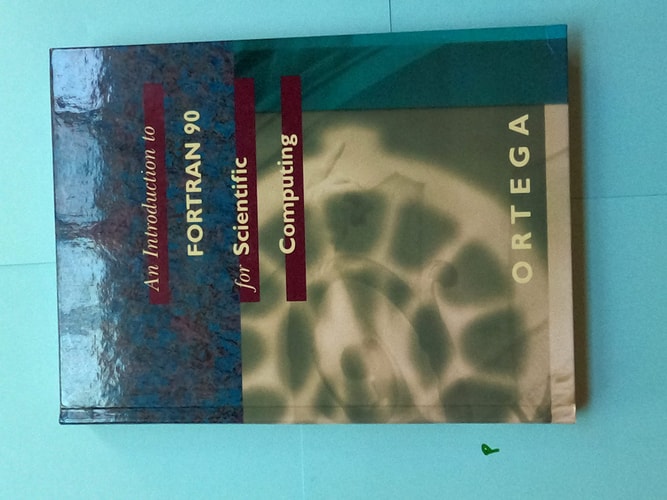
An Introduction to Fortran 90 for Scientific Computing
0
0
As an Amazon Associate and affiliate partner, Menrva Books earns from qualifying purchases. Learn more
Author Description
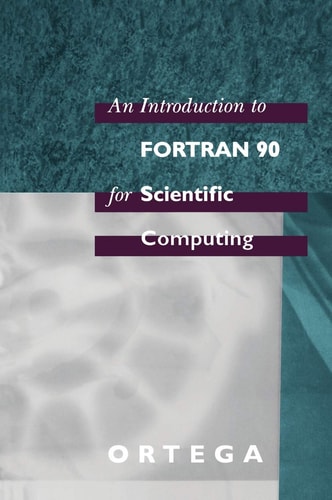
Fortran was one of the earliest programming languages and is still the most important language for scientific and engineering computation. It has evolved considerably over the last 35 years and this book provides an introduction to its latest standard: Fortran 90. The general organization of this text is based on a companion volume, An Introduction to FORTRAN for Scientific Computing, which covered Fortran 77 with some discussion of Fortran 90 features. Ortega begins with a general introduction to computing, then introduces the basic constructs of the Fortran language: variables, assignment statements, the IF statement, repetition by DO loops, arrays, functions and subroutines, and formatted input/output. Only the simplest forms of these constructs are introduced, but even these are enough for students to begin writing fairly sophisticated programs. To develop good programming habits early on, Ortega discusses programming techniques--such as top-down step-wise refinement, and the important question of detecting errors--alongside the factual material right from the beginning. By the end of Chapter 3, students will have covered most of Fortran 77 and many of the simpler added features of Fortran 90. In Chapter 4, Ortega addresses the more advanced features of Fortran 90: derived types, modules, interface blocks, overloading, and pointers, and concludes with a summary of how Fortran 77 differs from Fortran 90. Development of this text took place in many forms as a first-year programming course taught at the University of Virginia.
Menrva's Summary
THE THESIS
This text investigates the fundamental constructs and advanced capabilities of the Fortran 90 programming language within the context of scientific and engineering computation. James M. Ortega, a professor at the University of Virginia, utilizes his experience teaching first-year programming courses to structure this guide. The book provides a systematic framework for transitioning from basic programming concepts to the specific syntax and modular features introduced in the Fortran 90 standard.
THE SCOPE MAP
What You Will Find
- Core language constructs including variables, assignment statements, and DO loops
- Structured programming techniques such as top-down step-wise refinement
- Advanced Fortran 90 features including derived types, modules, and pointers
- Comparative analysis between Fortran 77 and Fortran 90 standards
Scope Limits
- Does not cover high-performance computing optimization techniques
- Excludes legacy Fortran 66 or earlier dialect specifics
- Focuses primarily on introductory and intermediate application rather than exhaustive compiler-specific implementation
THE AUTHORITY PERSPECTIVE
Experts recognize this text as a structured pedagogical resource for students transitioning into scientific programming. Readers frequently note the clarity of the progression from basic syntax to complex modular features.
Page Count:
240
Publication Date:
1994-07-01
Publisher:
Oxford University Press
ISBN-10:
0030101980
ISBN-13:
9780030101984
textbook
Scientific Computing
Computer Science
Fortran
Programming