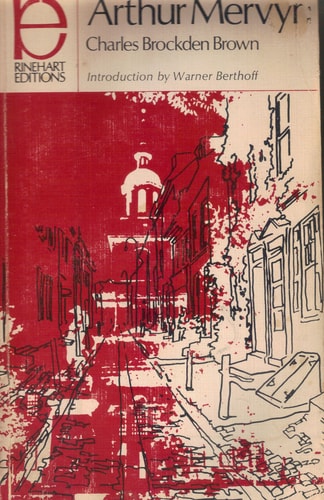
Arthur Mervyn
0
0
As an Amazon Associate and affiliate partner, Menrva Books earns from qualifying purchases. Learn more
Author Description
An excerpt of a review from "The Dublin University Magazine" [1838], Volume 13:ONE of the finest passages in modern fiction is the meeting between Watson and Welbeck in Brockden Brown's "Arthur Mervyn." The stern concentrated rage of the avenger - the more awful from its calmness - and the wordless resignation and despair of the wretched seducer are portrayed with a terrible faithfulness to nature.The introductory words of Watson - "It is well. The hour my vengeance has long thirsted for is arrived. Welbeck I that my first words could strike thee dead! They will so, if thou hast any claim to the name of man," - prepare us for the harrowing disclosures that follow - the death of Watson's sister "from anguish und a broken heart," and the suicide of their lunatic father in consequence. And when Watson, having narrated the latter circumstance, draws a pistol from his breast, and, approaching Welbeck, places the muzzle against his forehead, saying with forced calmness - "This is the instrument with which the deed was performed," who, even of those that cannot "feel" the scene, but must acknowledge the graphic nature of the conception?The duel, also, across the table, with its unlooked for result in the death of Watson, and the whole of the subsequent narrative of the interment of the corpse in the cellar - how peculiarly, but how powerfully they are given!Our interest in the entire affair is heightened by the singular character of Welbeck, who, by the way, is not at all like the Falkland of "Caleb Williams," though Dunlop, Brown's biographer, fancies he perceives a marked resemblance between them.Let us hope that "Arthur Mervyn" will find a place among the Standard Novels. It deserves the honor fully as much as "Edgar Huntly."
Menrva's Summary
THE PULSE
The arrival of a young, naive Arthur Mervyn in Philadelphia during a yellow fever epidemic initiates a series of encounters with deceitful figures that threaten his moral integrity. Mervyn seeks to establish himself in the city, but he quickly becomes entangled with the enigmatic and manipulative Welbeck. The narrative follows Mervyn as he navigates a landscape defined by urban decay, social instability, and the psychological machinations of those he encounters. The story utilizes a complex, often non-linear framework that emphasizes the protagonist's vulnerability against the backdrop of a rapidly shifting, perilous environment.
INSIDE THE PAGES
- First-person retrospective narration
- Detailed depiction of the 1793 Philadelphia yellow fever epidemic
- Exploration of moral ambiguity and corruption
- Use of the epistolary and confessional modes
- Focus on the psychological tension between characters
- Integration of Gothic elements within a realistic setting
- Examination of social class and economic desperation
- Emphasis on the loss of innocence in an urban environment
THE COLLECTIVE ECHO
Readers and critics frequently highlight the novel's intense psychological depth and its unflinching portrayal of human desperation during a public health crisis. Discussion often centers on the complex, often unreliable nature of the characters, particularly the antagonist Welbeck, whose motivations remain a subject of debate. Many observers note the effectiveness of the atmospheric writing, which captures the dread and isolation of a plague-stricken city with clinical precision. The work is often compared to other early Gothic novels for its focus on internal conflict and the corruption of the individual by societal forces. Readers interested in the evolution of the American novel find this text significant for its departure from traditional moralistic storytelling.
Page Count:
430
Publication Date:
1968-01-01
Publisher:
Holt, Rinehart
ISBN-10:
003010890X
ISBN-13:
9780030108907
Historical
Early American
Gothic
Classics
Psychological
Social Commentary