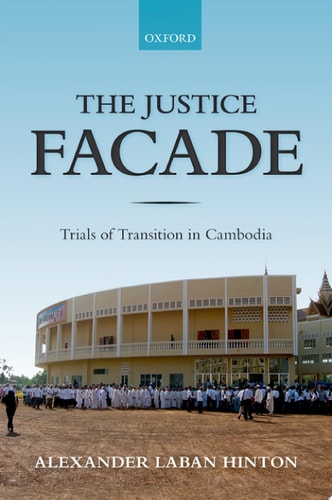
The Justice Facade: Trials of Transition in Cambodia
0
0
As an Amazon Associate and affiliate partner, Menrva Books earns from qualifying purchases. Learn more
Author Description
Is there a point to international justice?Many contend that tribunals deliver not only justice but truth, reconciliation, peace, democratization, and the rule of law. These are the transitional justice ideals frequently invoked in relation to the international hybrid tribunal in Cambodia that is trying senior leaders of the Khmer Rouge regime for genocide and crimes against humanity committed during the mid-to-late 1970s.In this ground-breaking book, Alexander Hinton argues these claims are a facade masking what is most critical: the ways in which transitional justice is translated, experienced, and understood in everyday life. Rather than reading the Khmer Rouge Tribunal in the language of global justice and human rights, survivors understand the proceedings in their own terms, including Buddhist beliefs and on-going relationships with the spirits of the dead.
Menrva's Summary
THE THESIS
This book investigates whether international tribunals effectively deliver justice and reconciliation by examining the gap between global legal ideals and the lived experiences of those affected by the Khmer Rouge regime. Alexander Laban Hinton, an anthropologist specializing in genocide studies, utilizes extensive ethnographic fieldwork to challenge the assumption that international hybrid tribunals inherently foster democratization or the rule of law. He argues that these legal proceedings often function as a facade, obscuring the complex, localized ways in which survivors interpret justice through their own cultural, religious, and spiritual frameworks.
THE SCOPE MAP
What You Will Find
- An analysis of the Khmer Rouge Tribunal and its international legal framework.
- Ethnographic research detailing how Cambodian survivors perceive and interpret legal proceedings.
- An exploration of the intersection between transitional justice and local Buddhist beliefs.
- A critical examination of the role of spirits and the dead in the survivor experience of justice.
THE AUTHORITY PERSPECTIVE
Experts in anthropology and international law recognize this work as a critical intervention in the study of transitional justice. Readers frequently note the author's ability to balance complex legal theory with the nuanced, personal perspectives of those living in the aftermath of genocide.
Page Count:
304
Publication Date:
2018-05-22
Publisher:
Oxford University Press
ISBN-10:
0198820941
ISBN-13:
9780198820949
History
Sociology
Genocide
Justice Administration of
Law_cambodia
Human rights
Professional Career & Trade
Law
Cambodia