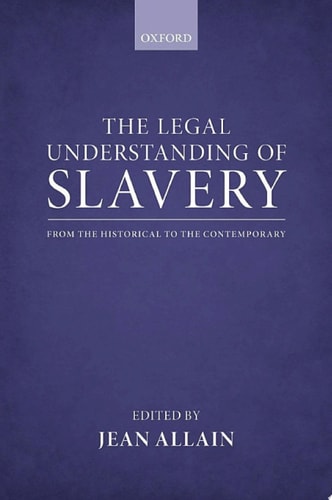
The Legal Understanding of Slavery: From the Historical to the Contemporary
0
0
As an Amazon Associate and affiliate partner, Menrva Books earns from qualifying purchases. Learn more
Author Description
"Slavery is the status or condition of a person over whom any or all of the powers attaching to the right of ownership are exercised." So reads the legal definition of slavery agreed by the League of Nations in 1926. Further enshrined in law during international negotiations in 1956 and 1998, this definition has been interpreted in different ways by the international courts in the intervening years. What can be considered slavery? Should forced labour be considered slavery? Debt-bondage? Child soldiering? Or forced marriage? This book explores the limits of how slavery is understood in law. It shows how the definition of slavery in law and the contemporary understanding of slavery has continually evolved and continues to be contentious. It traces the evolution of concepts of slavery, from Roman law through the Middle Ages, the 18th and 19th centuries, up to the modern day manifestations, including manifestations of forced labour and trafficking in persons, and considers how the 1926 definition can distinguish slavery from lesser servitudes. Together the contributors have put together a set of guidelines intended to clarify the law where slavery is concerned. The Bellagio-Harvard Guidelines on the Legal Parameters of Slavery, reproduced here for the first time, takes their shared understanding of both the past and present to project a consistent interpretation of the legal definition of slavery for the future.
Menrva's Summary
THE THESIS
This book investigates the legal parameters of slavery by examining how the 1926 League of Nations definition has evolved and been interpreted across historical and contemporary contexts. Jean Allain, a scholar specializing in international law and human rights, compiles contributions that analyze the shifting boundaries between slavery and other forms of servitude. The text argues that the legal definition remains contentious and requires a consistent framework to address modern manifestations such as trafficking and forced labor.
THE SCOPE MAP
What You Will Find
- Historical analysis of slavery from Roman law through the 19th century
- Legal examination of the 1926, 1956, and 1998 international agreements
- The Bellagio-Harvard Guidelines on the Legal Parameters of Slavery
- Comparative study of forced labor, debt-bondage, and child soldiering
Scope Limits
- Does not provide a comprehensive sociological study of slavery outside of legal frameworks
- Focuses primarily on international legal definitions rather than domestic statutes of individual nations
THE AUTHORITY PERSPECTIVE
Legal scholars and human rights practitioners frequently cite this work as a foundational text for understanding the nuances of international anti-slavery law. Experts highlight the inclusion of the Bellagio-Harvard Guidelines as a critical resource for clarifying the application of legal definitions in modern judicial settings.
Page Count:
415
Publication Date:
2012-01-01
Publisher:
OUP Oxford
ISBN-10:
0191645354
ISBN-13:
9780191645358
History
Law And Legislation
Human rights
Professional Career & Trade
Sociology
International Law
Law
Community Tags
Similar Books