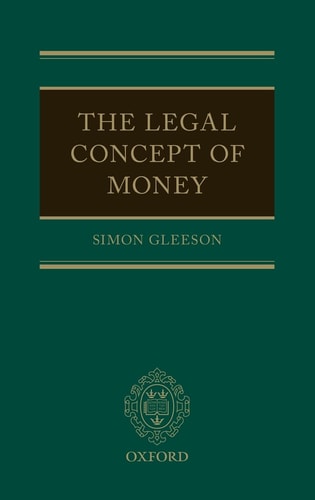
The Legal Concept of Money
0
0
As an Amazon Associate and affiliate partner, Menrva Books earns from qualifying purchases. Learn more
Author Description
This new book analyses the challenge of how money (including coins, notes, credit, and virtual currency) should be defined from both a legal and an economic perspective.As new electronic payment mechanisms proliferate, this question of definition is likely to become an important issue in global legal, commercial, economic, macro-prudential and fiscal policymaking. The book re-examines 'money' in this context by identifying the role it plays in various transactions and to what extent, for example, cryptocurrencies and 'quasi-money' are interchangeable with, analogous to, or different from traditional monetary systems.Beginning with a summary of the legal nature of money, the book explains the distinction between money and payment obligations, as well as providing an overview of the fundamental characteristics of money. It analyses how the law identifies money by pinpointing characteristics of particular transactions such as sale of goods transactions, including the position where the exchange of goods is for 'e-currency'.Other situations or transactions examined include the recovery of stolen money, claims for non-delivery of money, and how obligations to pay operate. The book also considers the role of money in the banking system, exploring how various currencies can be used as claims on financial institutions, examining whether the systemic stability of the industry is threatened by non-traditional currency forms. Finally, the book addresses, and seeks to develop a conceptual framework for how alternative currencies might work in place of money as a medium for saving.
Menrva's Summary
THE THESIS
This book investigates the fundamental challenge of defining money—encompassing physical currency, credit, and virtual assets—within the evolving landscape of global legal and economic systems. Simon Gleeson, a recognized expert in financial law, utilizes a rigorous analytical framework to bridge the gap between traditional monetary theory and modern electronic payment mechanisms. By examining the functional role of money in diverse transactions, the author argues that current legal definitions must adapt to accommodate the rise of cryptocurrencies and quasi-monetary instruments to ensure systemic stability.
THE SCOPE MAP
What You Will Find
- A comprehensive legal analysis of the distinction between money and payment obligations.
- Examination of transaction-specific legal precedents, including the sale of goods via e-currency.
- An exploration of the banking system's reliance on currency as a claim on financial institutions.
- A proposed conceptual framework for the integration of alternative currencies as mediums for saving.
THE AUTHORITY PERSPECTIVE
Legal scholars and financial practitioners identify this work as a critical resource for understanding the intersection of technology and monetary law. Readers frequently note the high level of academic density and the precise, technical nature of the prose, which serves as a foundational text for those involved in macro-prudential and fiscal policymaking.
Page Count:
256
Publication Date:
2019-02-20
Publisher:
Oxford University Press
ISBN-10:
0198826397
ISBN-13:
9780198826392
Economics
Finance
Money
Law
Professional Career & Trade
Cryptocurrency
Banking