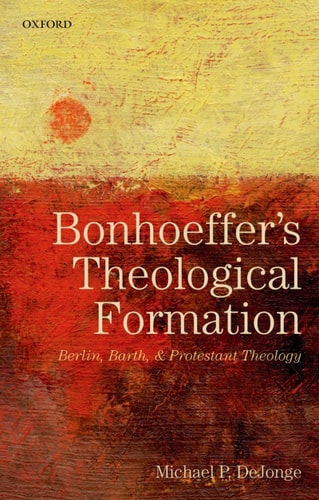
Bonhoeffer's Theological Formation: Berlin, Barth, and Protestant Theology
0
0
As an Amazon Associate and affiliate partner, Menrva Books earns from qualifying purchases. Learn more
Author Description
Dietrich Bonhoeffer's dramatic biography, a son of privilege who suffered imprisonment and execution after involving himself in a conspiracy to kill Hitler and overthrow the Third Reich, has helped make him one of the most influential Christian figures of the twentieth century. But before he was known as a martyr or a hero, he was a student and teacher of theology. This book examines the academic formation of Dietrich Bonhoeffer's theology, arguing that the young Bonhoeffer reinterpreted for a modern intellectual context the Lutheran understanding of the 'person' of Jesus Christ. In the process, Bonhoeffer not only distinguished himself from both Karl Barth and Karl Holl, whose dialectical theology and Luther interpretation respectively were two of the most important post-World War I theological movements, but also established the basic character of his own 'person-theology.'Barth convinces Bonhoeffer that theology must understand revelation as originating outside the human self in God's freedom. But whereas Barth understands revelation as the act of an eternal divine subject, Bonhoeffer treats revelation as the act and being of the historical person of Jesus Christ. On the basis of this person-concept of revelation, Bonhoeffer rejects Barth's dialectical thought, designed to respect the distinction between God and world, for a hermeneutical way of thinking that begins with the reconciliation of God and world in the person of Christ. Here Bonhoeffer mines a Lutheran understanding of the incarnation as God's unreserved entry into history, and the person of Christ as the resulting historical reconciliation of opposites. This also distinguishes Bonhoeffer's Lutheranism from that of Karl Holl, one of Bonhoeffer's teachers in Berlin, whose location of justification in the conscience renders the presence of Christ superfluous. Against this, Bonhoeffer emphasizes the present person of Christ as the precondition of justification. Through these critical conversations, Bonhoe
Menrva's Summary
THE THESIS
This book investigates the academic and intellectual development of Dietrich Bonhoeffer, specifically focusing on how his early theological training shaped his unique 'person-theology.' Michael P. DeJonge, a scholar of Bonhoeffer's work, analyzes the young theologian's engagement with the dominant intellectual currents of post-World War I Germany. By examining Bonhoeffer's critical interactions with Karl Barth and Karl Holl, the author argues that Bonhoeffer moved beyond existing dialectical frameworks to establish a theology centered on the historical person of Jesus Christ as the reconciliation of God and the world.
THE SCOPE MAP
What You Will Find
- An analysis of the post-World War I German theological landscape, specifically the influence of Karl Barth and Karl Holl.
- A detailed examination of Bonhoeffer's reinterpretation of Lutheran concepts regarding the incarnation and justification.
- A scholarly exploration of the 'person-concept' of revelation as the foundation of Bonhoeffer's mature theological thought.
- A study of the academic environment in Berlin that facilitated Bonhoeffer's early intellectual maturation.
THE AUTHORITY PERSPECTIVE
Scholars and theologians recognize this work as a significant contribution to the study of Bonhoeffer's intellectual history, moving beyond his well-known biography to focus on his rigorous academic foundations. Readers frequently note the academic density of the prose, which is intended for those with a background in systematic theology or historical studies.
Page Count:
176
Publication Date:
2018-06-26
Publisher:
Oxford University Press
ISBN-10:
019882713X
ISBN-13:
9780198827139
Philosophy
Biography
History
Christianity
Theology
Philosophical theology
Community Tags
Similar Books