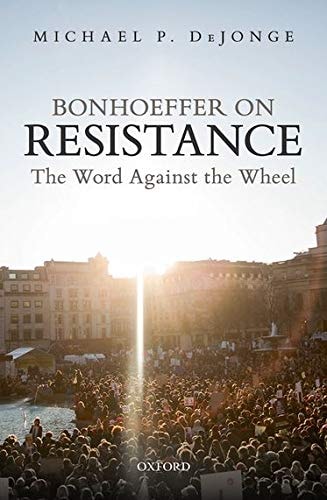
Bonhoeffer on Resistance: The Word Against the Wheel
0
0
As an Amazon Associate and affiliate partner, Menrva Books earns from qualifying purchases. Learn more
Author Description
Bonhoeffer thought and wrote a great deal about political life, but he did so neither as a political theorist nor a political activist but rather as a Christian pastor and theologian. Most of what he said about political resistance was said as a theologian, as one speaking on behalf of the church. For this reason, his thinking about political resistance can only be understood in the broader context of his theology. Bonhoeffer on Resistance provides an account of Bonhoeffer's resistance thinking as a whole. This involves placing his thinking about violent political resistance in the context of his thinking about resistance of all kinds; placing his thinking about political resistance of all kinds into the context of his thinking about political life in general; and, ultimately, placing his thinking about political life in the broader context of his theology, his thinking about the whole world and God's relationship to it.To establish the conceptual background necessary for understanding Bonhoeffer's resistance thinking, Michael P. DeJonge begins with a brief account of the theological story in which Bonhoeffer imbeds his account of political life: the story of God's creation of the world, the fall of that world into sin, and the redemption of that world in Christ. He introduces some specifically Lutheran accents to Bonhoeffer's theology that are essential for understanding his political vision, such as the doctrine of justification and the distinction between law and gospel. DeJonge then transitions from Bonhoeffer's theology into his political thinking by presenting the basic conceptual structures he employs when thinking through most political issues. Two important agents or institutions in political life are church and state, and DeJonge presents Bonhoeffer's account of these in light of the material presented in the previous chapters. The volume then presents Bonhoeffer's resistance thinking and activity, which can be considered from two overlapping perspectives,
Menrva's Summary
THE THESIS
This book investigates how Dietrich Bonhoeffer’s theological framework informs his specific views on political resistance and the role of the church within the state. Michael P. DeJonge, a scholar of Bonhoeffer’s work, argues that Bonhoeffer’s political stance cannot be separated from his identity as a pastor and theologian. By examining the intersection of Lutheran doctrine, the concepts of law and gospel, and the relationship between God and the world, the author provides a comprehensive account of how Bonhoeffer conceptualized resistance as a theological necessity rather than a purely political act.
THE SCOPE MAP
What You Will Find
- An analysis of Bonhoeffer’s theological narrative, including creation, the fall, and redemption.
- An examination of the institutional relationship between the church and the state.
- A detailed breakdown of the distinction between law and gospel within a political context.
- A systematic overview of Bonhoeffer’s resistance thinking, ranging from general political life to specific acts of violent resistance.
THE AUTHORITY PERSPECTIVE
Scholars and theologians recognize this work as a significant contribution to the study of Bonhoeffer’s political ethics. Readers frequently note the academic density of the prose, which serves as a foundational text for those seeking to understand the theological underpinnings of Bonhoeffer’s resistance.
Page Count:
192
Publication Date:
2018-10-30
Publisher:
Oxford University Press
ISBN-10:
0198824173
ISBN-13:
9780198824176
Biography
History
Philosophy
Christianity
Ethics
Theology
Community Tags
Similar Books