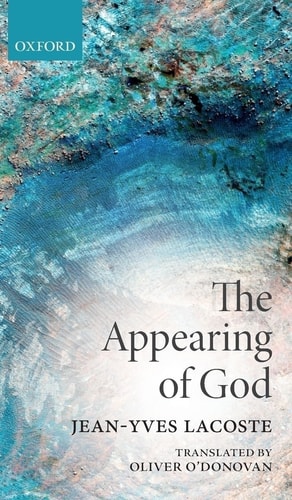
The Appearing of God
0
0
As an Amazon Associate and affiliate partner, Menrva Books earns from qualifying purchases. Learn more
Author Description
The nine essays in The Appearing of God are situated on the fluid border of philosophy and theology, and follow a path leading from classic modern philosophical discussions of experience to some leading themes in contemporary phenomenology. After an introductory exploration of Kierkegaard's classic text that straddles the border between philosophy and theology, the reader is introduced to Husserl's account of perception, with its demonstration that the field of phenomena is wider than that of perceptible entities, allowing phenomena that give themselves primarily to feeling. Husserl's theory of reduction is then subjected to a critique, which identifies phenomena wholly resistant to reduction. John Paul II's encyclical on Faith and Reason elicits a critical rejection of its attempt to reify the boundary between natural and supernatural, the author asserting in its place that love is the distinguishing mark of the knowledge of God. This theme is continued in a discussion of Heidegger's Being and Time, where a passing reference to Pascal invites interrogation of the work's 'methodological atheism', which is found to leave more room than appears for love of the divine. The next three chapters deal with the themes of Anticipation, Gift and Self-Identity, all exploring aspects of a single theme, the relation of present experience to the passage of time, and especially to the future. The final chapter puts that theme, together with the theme of love and knowledge, to the service of an enquiry into how theology as an intellectual enterprise relates to the practice of worship.
Menrva's Summary
THE THESIS
This collection of essays investigates the intersection of philosophical phenomenology and theological inquiry to determine how the divine manifests within human experience. Jean-Yves Lacoste, a scholar of continental philosophy and theology, utilizes a rigorous analytical framework to bridge the gap between secular philosophical methods and religious belief. By examining the works of thinkers such as Kierkegaard, Husserl, and Heidegger, the author argues that traditional boundaries between natural and supernatural knowledge are insufficient, proposing instead that love serves as the primary mechanism for understanding the divine.
THE SCOPE MAP
What You Will Find
- Critical analysis of Husserl’s theory of reduction and the limits of perceptible phenomena.
- Philosophical interrogation of methodological atheism within Heidegger’s Being and Time.
- Exploration of temporal themes including anticipation, the nature of the gift, and self-identity.
- A synthesis of theological intellectualism and the practical requirements of worship.
THE AUTHORITY PERSPECTIVE
Scholars and students of continental philosophy frequently note the high level of academic density and technical precision required to engage with Lacoste’s arguments. Experts highlight this work as a significant contribution to the field of phenomenological theology, particularly for its nuanced critique of modern philosophical boundaries.
Page Count:
224
Publication Date:
2018-12-25
Publisher:
Oxford University Press
ISBN-10:
0198827148
ISBN-13:
9780198827146
Philosophy
Religion
Metaphysics
Phenomenology
Theology
Philosophical theology
Community Tags
Similar Books