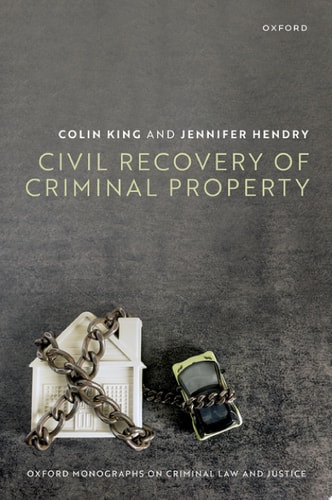
Civil Recovery of Criminal Property
0
0
As an Amazon Associate and affiliate partner, Menrva Books earns from qualifying purchases. Learn more
Author Description
'Follow-the-money' approaches are increasingly being adopted to tackle organised crime, corruption, and terrorist activities. The rationale behind such an approach is oft stated: to show that crime does not pay, to reinforce confidence in a fair and effective criminal justice system, and to deter criminal activity. Civil Recovery of Criminal Property is an in-depth analysis of the confiscation of the proceeds of crime in the absence of criminal conviction in Ireland and England & Wales, more than two decades since the introduction of this civil/criminal hybrid procedure. This book considers the development of civil recovery in both jurisdictions, providing a comprehensive comparative account and critical examination of its legislative context and framework, judicial reception, and case law development. It leads the argument that civil recovery -- like other civil/criminal hybrids -- straddles civil and criminal procedure in a manner that takes advantage of the resultant legal ambiguity, to the detriment of due process, civil liberties, and human rights. Through interviews with practitioners professionally engaged with civil recovery proceedings, both in defence and in enforcement, King and Hendry remedy what has until now been a lack of empirical engagement with the operation of civil recovery in practice. The authors provide a wide-ranging analysis of civil recovery in terms of its procedural hybridity, its 'follow-the-money' approach, its questionable compliance with the requirements of due process, its property-specific character, and its supposed pragmatism in tackling the problem of serious and organised crime. Blending doctrinal, socio-legal, and theoretical perspectives, Civil Recovery of Criminal Property will appeal both to academics and practitioners engaged with civil recovery.
Menrva's Summary
THE THESIS
This book investigates the legal and ethical implications of civil recovery procedures used to confiscate criminal property without a criminal conviction. Authors Colin King and Jennifer Hendry utilize a blend of doctrinal analysis and empirical research to argue that these hybrid legal mechanisms exploit procedural ambiguity. By examining the intersection of civil and criminal law, the authors contend that such practices often undermine fundamental due process, civil liberties, and human rights protections in Ireland and England & Wales.
THE SCOPE MAP
What You Will Find
- Comparative analysis of civil recovery frameworks in Ireland and England & Wales over the last two decades.
- Empirical data derived from interviews with legal practitioners, including both defense attorneys and enforcement officials.
- Examination of the 'follow-the-money' approach as a strategy for combating organized crime, corruption, and terrorism.
- Critical evaluation of the procedural hybridity and property-specific character of non-conviction-based asset forfeiture.
THE AUTHORITY PERSPECTIVE
Experts recognize this work as a significant contribution to the socio-legal study of asset recovery, particularly for its inclusion of practitioner perspectives. Readers frequently note the academic density of the prose, which makes it a primary resource for legal scholars and practitioners navigating the complexities of criminal justice reform.
Page Count:
240
Publication Date:
2023-01-01
Publisher:
Oxford University Press
ISBN-10:
0198824254
ISBN-13:
9780198824251
Criminal Law
Criminology
Human rights
Law
Legal Theory
Civil Law
Community Tags
Other Editions(2)

Similar Books





Reader Comments
Share Your Thoughts
No comments yet. Be the first to share your thoughts!