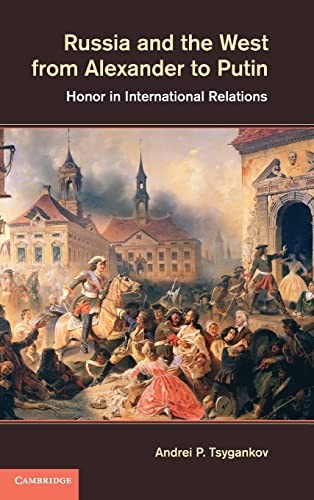
Russia and the West from Alexander to Putin
0
0
As an Amazon Associate and affiliate partner, Menrva Books earns from qualifying purchases. Learn more
Author Description
Since Russia has re-emerged as a global power, its foreign policies have come under close scrutiny. In Russia and the West from Alexander to Putin, Andrei P. Tsygankov identifies honor as the key concept by which Russia's international relations are determined. He argues that Russia's interests in acquiring power, security and welfare are filtered through this cultural belief and that different conceptions of honor provide an organizing framework that produces policies of cooperation, defensiveness and assertiveness in relation to the West. Using ten case studies spanning a period from the early nineteenth century to the present day - including the Holy Alliance, the Triple Entente and the Russia-Georgia war - Tsygankov's theory suggests that when it perceives its sense of honor to be recognized, Russia cooperates with the Western nations; without such a recognition it pursues independent policies either defensively or assertively. The student of politics who looks only at patterns of behavior but leaves out the meaning that actors give to their own and to each other's conduct turns into a specialist of shadows. Robert Legvold The Question of Russia's International Motives From a weak and inward-looking nation in the 1990s, Russia has emerged into a power that is increasingly capable of defending its international prestige using available economic and military means. Throughout the 2000s, it has exploited its energy clout to expand Russian business relations abroad and cemented its military presence in the strategic area of the Caucasus by defeating Georgia's attack on South Ossetia. In a world that is increasingly post-American and post-Western, Russia is likely to remain an influential power in the critically important Eurasian region. Even the unprecedented rise of China does not change the fact that Russia possesses a large arsenal of nuclear weapons, abundant supplies of natural resources, and the longest geographic border in the world. With a seat on the
Menrva's Summary
THE THESIS
This book investigates how the concept of honor has shaped Russia's foreign policy and its relationship with the West throughout history. Andrei P. Tsygankov, a political scientist, posits that Russia's pursuit of power, security, and welfare is fundamentally filtered through its cultural understanding of honor. The book examines how differing conceptions of honor lead to distinct policy approaches, ranging from cooperation to assertiveness, in Russia's interactions with Western nations. Tsygankov utilizes ten historical case studies to support his theory, demonstrating how Russia's perception of its honor being recognized or disregarded influences its international conduct.
THE SCOPE MAP
- Analysis of Russia's foreign policy through the lens of honor as a determining factor.
- Ten historical case studies spanning from the early 19th century to the present day.
- Examination of key historical periods such as the Holy Alliance and the Triple Entente.
- Discussion of contemporary foreign policy, including the Russia-Georgia war.
- Exploration of Russia's re-emergence as a global power and its international relations.
- Theories on how Russia's sense of honor influences its cooperation, defensiveness, or assertiveness towards the West.
THE AUTHORITY PERSPECTIVE
The book is regarded as a significant contribution to understanding Russian foreign policy, with its central thesis on honor providing a novel framework for analysis. Tsygankov's use of historical case studies offers a comprehensive perspective on the evolution of Russia's international relations. The work is likely to be of interest to scholars and students of political science, international relations, and Russian history. The analysis suggests a nuanced view of Russia's actions, linking them to deep-seated cultural beliefs about national prestige and recognition.
Page Count:
330
Publication Date:
2012-01-01
ISBN-10:
1107025524
ISBN-13:
9781107025523
Politics
Non-Fiction
History
Science
International relations
Community Tags
Other Editions(2)

Similar Books


Reader Comments
Share Your Thoughts
No comments yet. Be the first to share your thoughts!