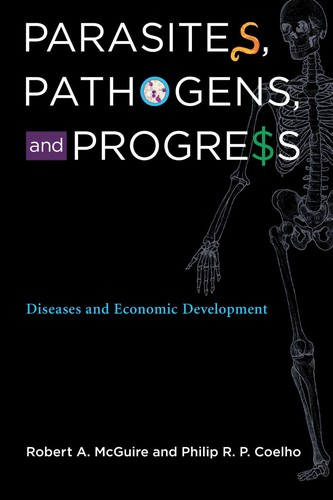
Parasites, Pathogens, and Progress
0
0
As an Amazon Associate and affiliate partner, Menrva Books earns from qualifying purchases. Learn more
Author Description
In Parasites, Pathogens, and Progress, Robert McGuire and Philip Coelho integrate biological and economic perspectives into an explanation of the historical development of humanity and the economy, paying particular attention to the American experience, its history and development. In their path-breaking examination of the impact of population growth and parasitic diseases, they contend that interpretations of history that minimize or ignore the physical environment are incomplete or wrong. The authors emphasize the paradoxical impact of population growth and density on progress. An increased population leads to increased market size, specialization, productivity, and living standards. Simultaneously, increased population density can provide an ecological niche for pathogens and parasites that prey upon humanity, increasing morbidity and mortality. The tension between diseases and progress continues, with progress dominant since the late 1800s. Integral to their story are the differential effects of diseases on different ethnic (racial) groups. McGuire and Coelho show that the Europeanization of the Americas, for example, was caused by Old World diseases unwittingly brought to the New World, not by superior technology and weaponry. The decimation of Native Americans by pathogens vastly exceeded that caused by war and human predation. The authors combine biological and economic analyses to explain the concentration of African slaves in the American South. African labor was more profitable in the South because Africans' evolutionary heritage enabled them to resist the diseases that became established there; conversely, Africans' ancestral heritage made them susceptible to northern "cold-weather" diseases. European disease resistance and susceptibilities were the opposite regionally. Differential regional disease ecologies thus led to a heritage of racial slavery and racism --
Menrva's Summary
THE THESIS
This book investigates the complex interplay between biological factors, specifically parasites and pathogens, and the trajectory of human and economic progress throughout history, with a particular focus on the Americas. The authors, Robert McGuire and Philip Coelho, argue that historical interpretations are incomplete if they disregard the physical environment and the impact of diseases. They explore the paradoxical relationship where population growth, while fostering economic development through increased markets and specialization, simultaneously creates conditions for disease proliferation. This tension between disease and progress has largely been resolved in favor of progress since the late 19th century, but the book also examines the differential impact of diseases on various ethnic groups, shaping historical events like the European colonization of the Americas and the concentration of African slaves in the American South.
THE SCOPE MAP
- An integration of biological and economic perspectives on human and economic history.
- An analysis of the impact of population growth and parasitic diseases on societal development.
- A focus on the historical experience and development of the Americas.
- Examination of the differential effects of diseases on different ethnic (racial) groups.
- Explanation of the role of Old World diseases in the Europeanization of the Americas.
- Analysis of the concentration of African slaves in the American South based on disease resistance.
THE AUTHORITY PERSPECTIVE
The book is presented as a path-breaking examination that integrates biological and economic perspectives to explain historical development. It challenges interpretations of history that minimize the physical environment and emphasizes the paradoxical impact of population density on progress and disease. The authors' analysis extends to the differential effects of diseases on ethnic groups, offering explanations for significant historical phenomena such as the European colonization of the Americas and the legacy of racial slavery.
Page Count:
343
Publication Date:
2011-01-01
ISBN-10:
0262015668
ISBN-13:
9780262015660
Science & Technology
Health
Non-Fiction
Economics
History
Community Tags
Similar Books














