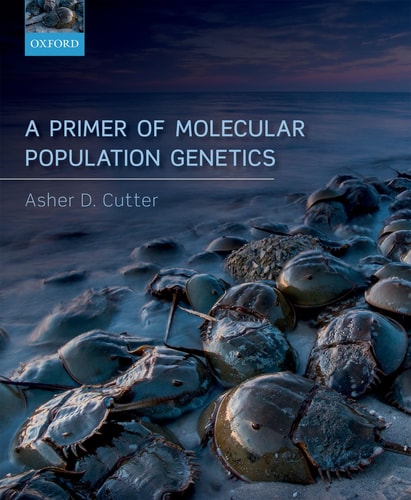
A Primer of Molecular Population Genetics
0
0
As an Amazon Associate and affiliate partner, Menrva Books earns from qualifying purchases. Learn more
Author Description
What are the genomic signatures of adaptations in DNA? How often does natural selection dictate changes to DNA? How does the ebb and flow in the abundance of individuals over time get marked onto chromosomes to record genetic history? Molecular population genetics seeks to answer such questions by explaining genetic variation and molecular evolution from micro-evolutionary principles. It provides a way to learn about how evolution works and how it shapes species by incorporating molecular details of DNA as the heritable material. It enables us to understand the logic of how mutations originate, change in abundance in populations, and become fixed as DNA sequence divergence between species. With the revolutionary advances in genomic data acquisition, understanding molecular population genetics is now a fundamental requirement for today's life scientists. These concepts apply in analysis of personal genomics, genome-wide association studies, landscape and conservation genetics, forensics, molecular anthropology, and selection scans. This book introduces, in an accessible way, the bare essentials of the theory and practice of molecular population genetics.
Menrva's Summary
THE THESIS
This book investigates the fundamental mechanisms of molecular population genetics to explain how genetic variation and evolutionary processes shape the DNA of species. Prof. Asher D. Cutter, a specialist in evolutionary biology, utilizes micro-evolutionary principles to bridge the gap between theoretical population genetics and modern genomic data. The text provides a structured framework for understanding how mutations arise, fluctuate in frequency, and eventually become fixed within populations over time.
THE SCOPE MAP
What You Will Find
- Theoretical foundations of mutation, genetic drift, and natural selection
- Quantitative methods for analyzing DNA sequence divergence
- Applications in personal genomics and genome-wide association studies
- Methodologies for landscape, conservation, and forensic genetics
THE AUTHORITY PERSPECTIVE
Experts identify this text as a clear, foundational resource for life scientists seeking to integrate genomic data with evolutionary theory. Readers frequently note the accessibility of the prose, which effectively distills complex mathematical and biological concepts for students and researchers alike.
Page Count:
272
Publication Date:
2019-08-06
Publisher:
Oxford University Press
ISBN-10:
0198838956
ISBN-13:
9780198838951
Science
Genetics
textbook
Evolutionary Biology
Biology
Community Tags
Similar Books