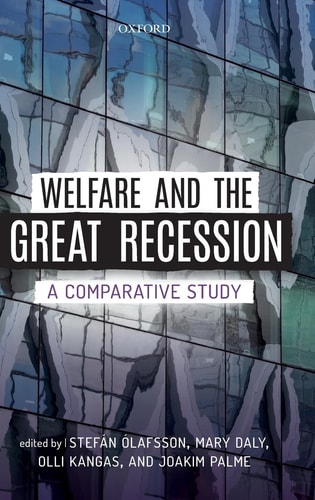
Welfare and the Great Recession: A Comparative Study
0
0
As an Amazon Associate and affiliate partner, Menrva Books earns from qualifying purchases. Learn more
Author Description
Welfare and the Great Recession surveys and analyses welfare consequences in the period following the financial crisis in Europe. It investigates how the burdens of the recession were shared between countries, between different socio-economic groups across Europe, and within individual countries, and offers new evidence that demonstrates the importance of the welfare state and government policies in sheltering populations from serious economic contraction.The first comprehensive study of the Great Recession in Europe that focuses on household level welfare consequences, this edited volume relates financial hardship to institutional characteristics such as welfare regimes, currency regimes, socio-political patterns, affluence levels, public debt, and policy reactions to periods of crisis. It takes into account stimulus versus austerity, the degree of social protection emphasis, the commitment to redistribution, and the significance of activism. Widely comparative, Welfare and the Great Recession combines comparisons of thirty countries with an in-depth study of nine country cases to offer various lessons from the crisis experience in Europe and reflect on welfare futures in a globalized crisis-prone environment.
Menrva's Summary
THE THESIS
This volume investigates how the welfare state and specific government policies mitigated or exacerbated the socio-economic consequences of the Great Recession across Europe. Edited by Joakim Palme, Mary Daly, Olli Kangas, and Stefán Ólafsson, the work synthesizes cross-national data to evaluate how different institutional frameworks influenced household-level financial hardship. The authors argue that the resilience of a population during economic contraction is directly tied to the specific design of national welfare regimes and the political choices made regarding stimulus versus austerity measures.
THE SCOPE MAP
What You Will Find
- Comparative analysis of thirty European countries regarding welfare outcomes.
- In-depth case studies of nine specific nations to illustrate policy impacts.
- Quantitative and qualitative data on household-level financial hardship.
- Evaluation of institutional variables including currency regimes, public debt, and redistribution commitments.
THE AUTHORITY PERSPECTIVE
Experts recognize this volume as a foundational comparative study for understanding the intersection of social policy and macroeconomic crisis management. Scholars frequently cite the text for its rigorous methodology and its ability to bridge the gap between national policy decisions and individual household welfare outcomes.
Page Count:
352
Publication Date:
2019-03-21
Publisher:
Oxford University Press
ISBN-10:
0198830963
ISBN-13:
9780198830962
Economics
Public welfare
Sociology
Recessions
European History
Public Policy
Community Tags
Similar Books